
AI Song Prompts That Actually Change the Output
AI song prompts steer output when they change the model's job: set speaker + action, add a not-this-story boundary, supply a singable image list, control hook behavior, and define arrangement texture.
I tested that with a fresh WriteSong.AI Simple Mode run around Coffee At Closing Time, then compared the visible lyric openings, public tags, cover direction, and candidate runtimes.
Short Answer
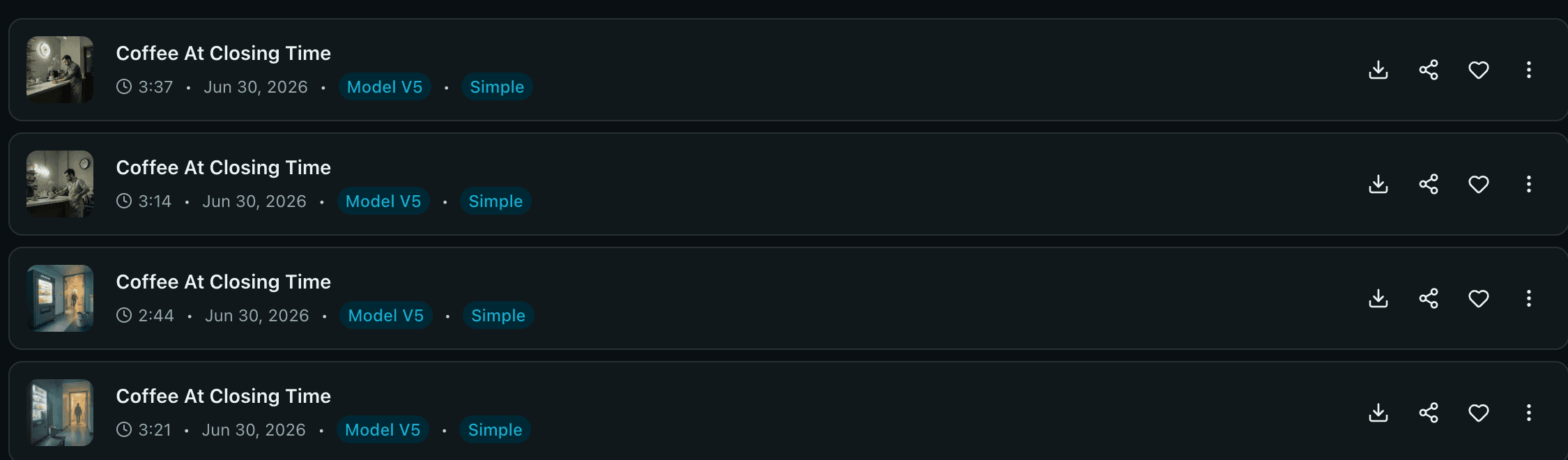
In this test, the broad prompt produced two Coffee At Closing Time candidates at 2:44 and 3:21. The revised prompt produced two new candidates at 3:37 and 3:14, with different visible lyric imagery and different public tags.
The useful move was not adding more adjectives. It was changing the job: speaker + action, not-this-story boundary, singable image list, hook behavior, and arrangement texture.
Use the formulas as revision checks after a first draft, not as a promise that every model run will reproduce the same song.
Evidence Summary
This fresh Coffee At Closing Time test was collected through foreground browser use. The parameters define the setup; the evidence rows focus on output signals and limits.
Test Parameters
Machine-readable summary: model=Model V5; mode=Simple Mode; date=2026-06-30; rounds=2; candidates_per_round=2; seed=not exposed.
| Model | Model V5 |
|---|---|
| Mode | Simple Mode |
| Date | 2026-06-30 |
| Rounds | 2 |
| Candidates per round | 2 |
| Seed | not exposed |
| Evidence | Observed value | Why it matters |
|---|---|---|
| Generation design | 2 prompt rounds, 2 candidates per round | The comparison uses the generated candidate pairs rather than treating one song as the whole result. |
| Seed control | No random seed control exposed in Simple Mode | Observed differences are practical prompt-revision evidence, not deterministic seed-locked A/B results. |
| Topic | Coffee At Closing Time | Fresh topic and fresh screenshots created for this article. |
| Round 1 output | 2 candidates: 2:44 and 3:21 | The opened player showed tags: indie pop, warm, emotional. |
| Round 2 output | 2 candidates: 3:37 and 3:14 | The opened player showed tags: indie folk, pop, ballad. |
| Capture method | Foreground Chrome clicks, typing, waiting, playback, screenshots | Screenshots were cropped to remove browser chrome, tabs, and account areas. |
| Limit | One test, not a universal benchmark | The formulas steered observable signals here; they still need listening and human judgment. |
The Before And After Prompts
Both prompts used the same test parameters. The after prompt changed several controls at once, so this is an evidence-led revision test, not a lab-isolated A/B test of five separate variables.
Round 1 prompt
Copy-ready Round 1 prompt
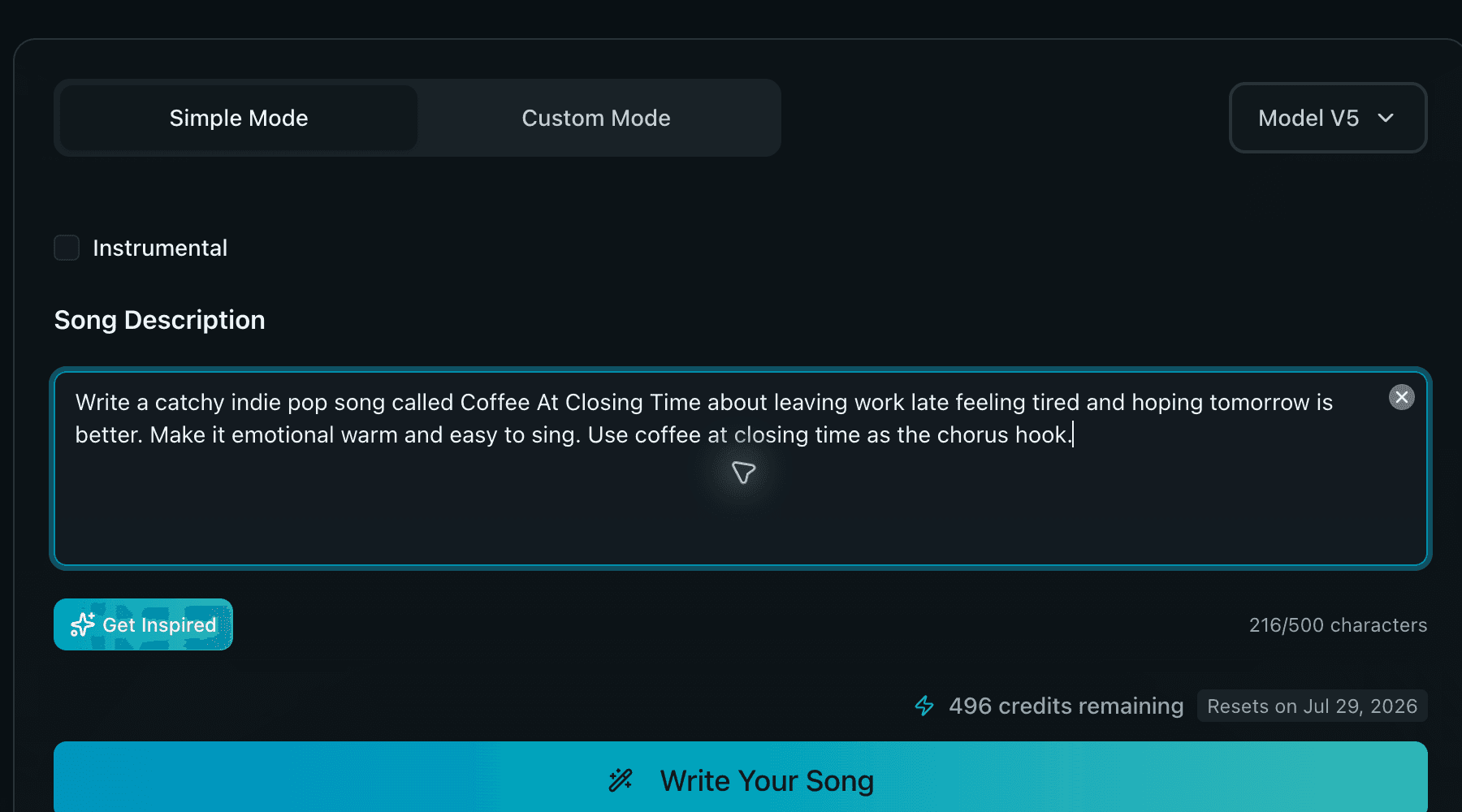
Write a catchy indie pop song called Coffee At Closing Time about leaving work late feeling tired and hoping tomorrow is better. Make it emotional warm and easy to sing. Use coffee at closing time as the chorus hook.Key control points
- Title and hook phrase were clear.
- Genre and mood were present.
- No specific speaker + action, not-this-story boundary, singable image list, or arrangement texture was supplied.
Round 2 prompt
Copy-ready Round 2 prompt
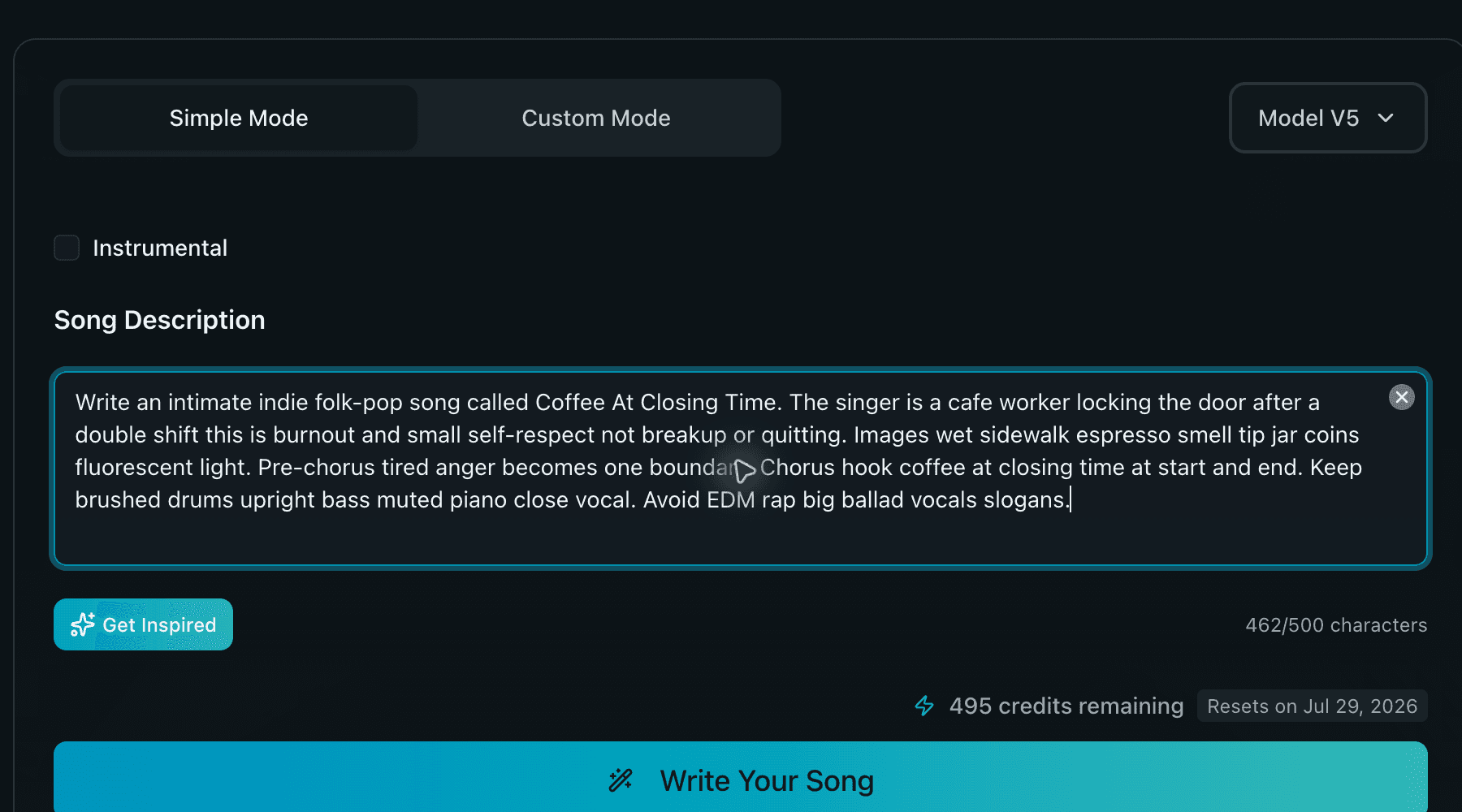
Write an intimate indie folk-pop song called Coffee At Closing Time. The singer is a cafe worker locking the door after a double shift this is burnout and small self-respect not breakup or quitting. Images wet sidewalk espresso smell tip jar coins fluorescent light. Pre-chorus tired anger becomes one boundary. Chorus hook coffee at closing time at start and end. Keep brushed drums upright bass muted piano close vocal. Avoid EDM rap big ballad vocals slogans.Key control points
- Speaker + action: a cafe worker locking the door after a double shift.
- Not-this-story boundary: burnout and small self-respect, not breakup or quitting.
- Singable image list: wet sidewalk, espresso smell, tip jar coins, fluorescent light.
- Hook behavior + arrangement texture: phrase at start and end, brushed drums, upright bass, muted piano, close vocal.
The Output Shifted In Visible Ways
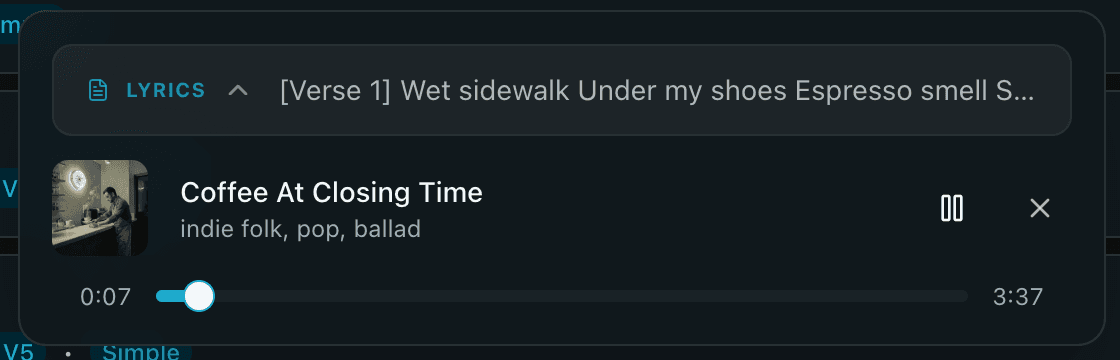
The My Songs list showed four Coffee At Closing Time outputs from the two rounds. I opened one candidate from each round in the visible player to compare lyrics and public tags.
Text Evidence For Non-Audio Review
This text version summarizes the visible player evidence for readers, crawlers, and assistive technology when audio playback is not available.
Round 1 opened player
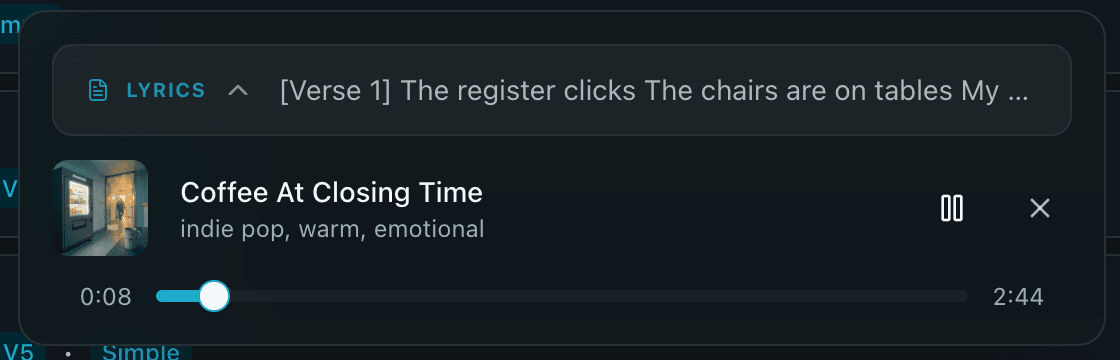
Visible lyric opening used workplace objects: register and chairs. Public tags read indie pop, warm, emotional. Candidate runtimes were 2:44 and 3:21.
Round 2 opened player
Visible lyric opening used the supplied sensory lane: wet sidewalk, under my shoes, espresso smell. Public tags read indie folk, pop, ballad. Candidate runtimes were 3:37 and 3:14.
Expand for full transcript
Round 1 transcript evidence
The visible player snippet begins with workplace-object imagery: register, chairs, and tables. The public tags visible in the player are indie pop, warm, emotional. The two Round 1 candidates in My Songs show durations of 2:44 and 3:21.
Round 2 transcript evidence
The visible player snippet begins with supplied sensory details: wet sidewalk, under my shoes, and espresso smell. The public tags visible in the player are indie folk, pop, ballad. The two Round 2 candidates in My Songs show durations of 3:37 and 3:14.
Five Prompt Formulas That Steered The Result
Each formula below pairs a prompt move with an output signal observed in this test. The controls were revised together, so use this as practical steering evidence, then verify the full song by listening.
Read this table as a field guide: each row gives the prompt control, the visible output signal from this test, and the quick check to run on your own generated candidates.
| Prompt formula | What changed | Evidence signal | Use when | Quick check |
|---|---|---|---|---|
| Speaker + action | The prompt moved from a general late-work mood to a cafe worker locking up after a double shift. | The after cover and opened player stayed closer to a specific workplace scene. | The first song feels like a mood board instead of a person in a scene. | Does the first verse show a role doing an action? |
| Not-this-story boundary | The revision named burnout and small self-respect, then excluded breakup and quitting. | The opened after snippet stayed in the work-scene lane with wet sidewalk and espresso smell. | A nearby default plot would make the song emotionally wrong. | Do unwanted breakup, quitting, or grief cues appear? |
| Singable image list | The revision supplied concrete objects, smell, light, and place details. | The opened after snippet used the supplied sensory lane immediately. | The first output summarizes feelings instead of giving lyric material. | Do supplied objects or sensory details appear early? |
| Hook behavior | The revision told the hook phrase where to appear instead of only naming it. | Both after candidates kept the title; full chorus placement still requires playback. | The exact hook phrase matters, but repetition should stay controlled. | Does the chorus use the hook where requested? |
| Arrangement texture | The revision specified brushed drums, upright bass, muted piano, close vocal, and avoid rules. | The opened after player showed different public tags and the candidate pair had different runtimes. | The topic is right, but the sonic frame is too broad. | Do tags and playback match the texture request? |
Speaker + action: Anchor lyrics by naming who sings and what they do.
1. Give the song a speaker, not just a mood
Formula
Write a [genre] song where [specific person] is doing [specific action].
Before prompt line
about leaving work late feeling tired and hoping tomorrow is better
Before output
The first opened candidate stayed broad: the visible lyric began with workplace objects, and the public tags stayed general: indie pop, warm, emotional.
After prompt line
The singer is a cafe worker locking the door after a double shift
After output
The after candidate kept the workplace but became more specific: the cover image showed a worker at the counter, and the opened player showed indie folk, pop, ballad.
Use this when the AI song feels like a mood board instead of a scene with a person inside it.
Quick check
Check whether the first verse names a person, place, or action instead of only describing a feeling.
Not-this-story boundary: Forbid plots that would change the meaning.
2. Add a not-this-story boundary
Formula
This is [core situation], not [nearby story you do not want].
Before prompt line
feeling tired and hoping tomorrow is better
Before output
The first prompt gave a feeling but not a boundary, so a later listener would still need to inspect whether the song became a breakup, quitting song, or generic motivation song.
After prompt line
this is burnout and small self-respect not breakup or quitting
After output
The visible after evidence does not prove every lyric line obeyed the boundary, but the opened snippet stayed inside the work scene: wet sidewalk, shoes, espresso smell.
Use this when a common adjacent plot would ruin the song even if the genre sounds right.
Quick check
Scan the opening lyric for unwanted plot cues such as breakup, quitting, grief, or generic motivation.
Singable image list: Give objects, smells, light, and place details.
3. Use images the lyric can actually sing
Formula
Images: [object], [smell], [place detail], [light or weather].
Before prompt line
leaving work late feeling tired and hoping tomorrow is better
Before output
The model invented usable workplace images: the visible lyric began, The register clicks, The chairs are on tables.
After prompt line
Images wet sidewalk espresso smell tip jar coins fluorescent light
After output
The opened after candidate used the supplied sensory lane immediately: Wet sidewalk, Under my shoes, Espresso smell.
Use this when you want the output to sound less like a summary and more like a lyric.
Quick check
Look for supplied nouns or sensory details in the first verse, not only abstract mood words.
Hook behavior: Tell the hook where to land and repeat.
4. Tell the hook how to behave
Formula
Chorus hook: [phrase] at [position or repetition rule].
Before prompt line
Use coffee at closing time as the chorus hook.
Before output
Round 1 kept the title and hook phrase, but the prompt did not say where the phrase should land or how much repetition was enough.
After prompt line
Chorus hook coffee at closing time at start and end.
After output
The visible list still produced the same title across both after candidates. The full chorus placement still needs human playback, so treat this as a steering rule, not a guarantee.
Use this when the hook phrase matters, but you do not want the AI to decide the repetition pattern alone.
Quick check
Play the chorus and count whether the hook phrase appears where you asked, without crowding every line.
Arrangement texture: Name instruments, vocal shape, and avoided genres.
5. Define the arrangement as texture
Formula
Keep [drums/bass/keys/vocal texture]. Avoid [genres or vocal shapes].
Before prompt line
catchy indie pop ... emotional warm and easy to sing
Before output
The public style tags reflected the broad request: indie pop, warm, emotional. That is usable, but it gives little production control.
After prompt line
Keep brushed drums upright bass muted piano close vocal. Avoid EDM rap big ballad vocals slogans.
After output
The opened after candidate showed indie folk, pop, ballad tags, and the pair landed at 3:37 and 3:14 instead of the first pair's 2:44 and 3:21.
Use this when the first output has the right topic but the wrong sonic frame.
Quick check
Compare the public tags and the first 20 seconds of playback against the instruments and avoid rules.
A Reusable Prompt Template
Use this when you want to write songs with AI and need more control than genre plus mood.
Copy-ready reusable prompt template
Write a [genre] song called [title].
The singer is [specific person] doing [specific action] in [place/time].
This is [core emotional frame], not [wrong adjacent story].
Images: [object], [smell/sound], [place detail], [light/weather].
Pre-chorus: [how the emotion turns].
Chorus hook: [exact hook phrase] at [placement or repetition rule].
Keep [drums], [bass], [keys/guitar], [vocal texture].
Avoid [unwanted genre], [unwanted vocal shape], [unwanted lyric habit].
How To Use The Formulas
Do not paste every control into every prompt. Start broad, generate two candidates, inspect what changed, then add the formula that solves the specific mismatch.
- Start with a title, genre, mood, and one-sentence situation.
- Generate two candidates so one random output does not define the whole test.
- Open a candidate and check the lyric opening, tags, duration, and cover direction.
- Name the mismatch: missing speaker + action, weak not-this-story boundary, weak singable image list, loose hook behavior, or wrong arrangement texture.
- Rewrite the next prompt around that mismatch instead of asking for a better song.
For a broader writing workflow, use the step-by-step guide to writing a song with AI. If you need words before audio, start with the AI lyrics generator.
FAQ
What is the best AI song prompt formula?
Start with this: write a song where a specific speaker performs a specific action, then add the emotional frame, a not-this-story boundary, a singable image list, hook behavior, and arrangement texture. The strongest formula depends on what the first output gets wrong.
Should I make AI song prompts longer?
Longer only helps when the extra words create control. In this test, the after prompt was longer because it added speaker + action, a not-this-story boundary, a singable image list, hook behavior, and arrangement texture. Extra adjectives by themselves are usually weaker.
Can prompt formulas guarantee the exact AI song output?
No. This test shows observable changes in title consistency, duration, visible lyric snippets, cover direction, and public tags. You still need to play the candidates and decide whether the full song works.
Why generate two candidates per prompt?
Two candidates make prompt testing less fragile. In this test, both rounds returned two Coffee At Closing Time songs, so the comparison could use a pair of outputs instead of treating one song as the whole result.
Where should I try these prompts?
Use AI Song Writer when you want a complete song with vocals and arrangement from a prompt. If you want to perfect words before audio, use the AI Lyrics Generator first and then move into song generation.
Read next
Continue through the blog cluster
Why AI Songs Sound Generic: 5 Prompt Fixes
Five practical prompt fixes for repetitive or unnatural AI songs, with before-and-after evidence and a copy-ready repair template.
Read articleHow to Write Better Choruses with AI
A chorus rewrite workflow with a prefilled prompt link, copy/run/download tracking, a 25-point scorecard, and clear text-level proof boundaries.
Read articlePrompt control starts after the first output.
Generate a real draft, find the visible mismatch, then revise the prompt around the exact thing the song needs next.
Write songs with AI