
Write a Song from Your Own Lyrics
Use a lyrics-first workflow to turn your written words into a clear AI listening draft. Paste sectioned lyrics in Custom Mode, keep style and vocal direction separate, generate, then judge by lyric fit before revising.
Reviewed by WriteSong.AI Editorial Team on June 30, 2026. Evidence status: Custom Mode screenshots and two public audio demos are available; ClaimReview is held until a narrow timestamped lyric-fit claim exists.
Short Answer
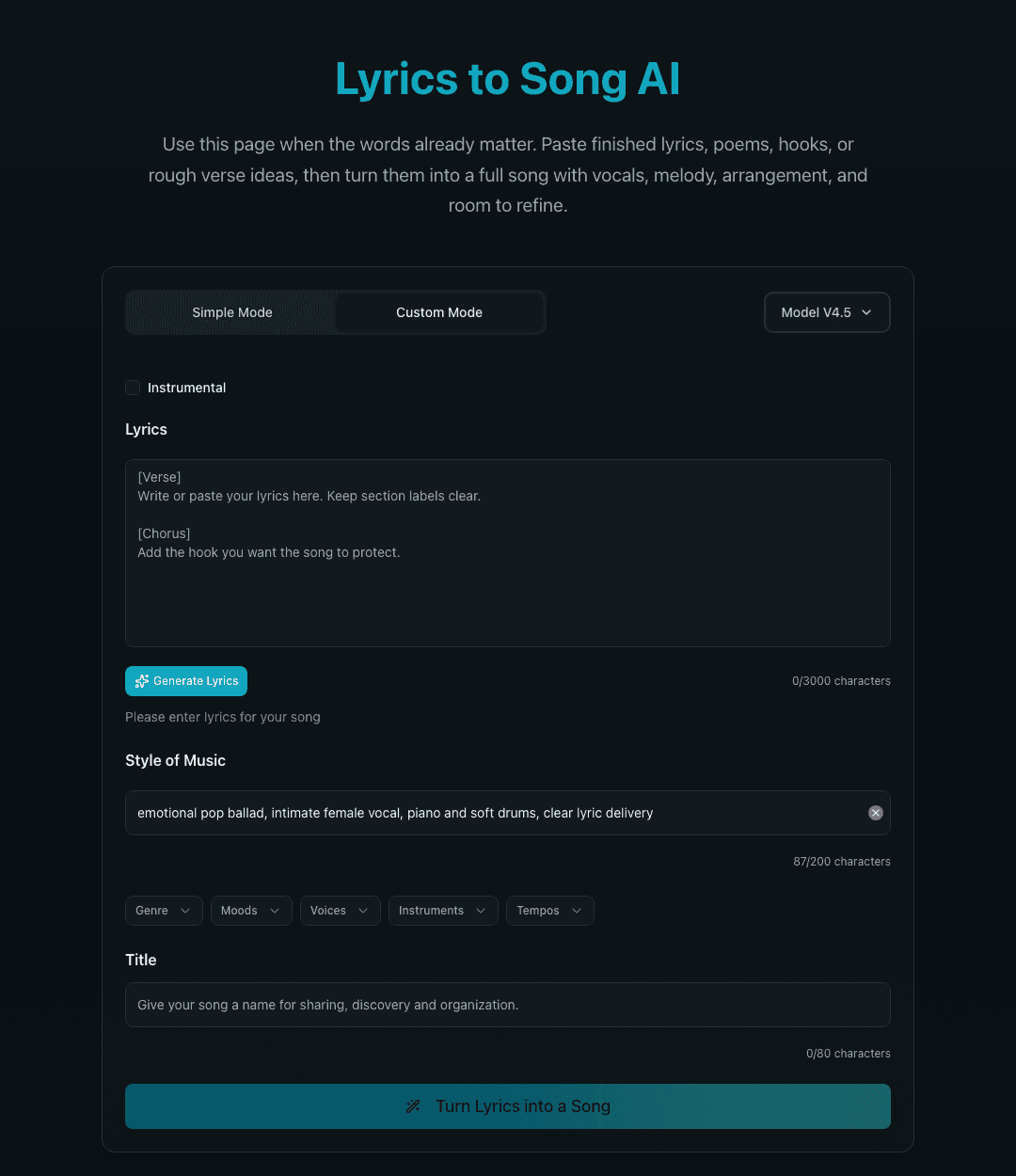
To write a song from your own lyrics with AI, paste lyrics in Custom Mode with section labels, put style and vocal direction outside the lyric text, generate a complete draft, then check whether the melody, syllable stress, hook, vocal role, and arrangement actually support the words.
The current evidence for this article includes product-surface screenshots and two generated Custom Mode audio drafts. The demos prove output existence, duration, and public availability; they do not prove every lyric-fit claim without timestamped human review.
Use the right mode
Choose Custom Mode or a lyrics to song AI workflow when the words already matter.
Preserve the hook
Mark the chorus and tell the model which phrase should stay clear and repeatable.
Separate sound from text
Keep style, vocal role, tempo feel, and avoid rules outside the lyric box.
Run lyric fit testing
Judge the draft by lyric clarity, syllable stress, chorus lift, and arrangement fit.
Evidence Boundary
This article follows the SOP by separating product evidence from output evidence. Screenshots show the lyrics-first workflow and UI controls. The audio players below show two completed Custom Mode outputs. AudioObject is present for those demos; ClaimReview is not.
Test Parameters
Machine-readable summary: route=/lyrics-to-song-ai; mode=Custom Mode; date=2026-06-30; evidence_type=product-surface screenshots plus generated audio demos; audio_demos=2; claim_review=not emitted.
| Evidence route | /lyrics-to-song-ai |
|---|---|
| Observed mode | Custom Mode |
| Visible model selector | Model V5 |
| Evidence date | 2026-06-30 |
| Input type | User-provided lyrics plus style direction |
| Audio claim | Two completed Custom Mode drafts are public and playable on this page: 1:14 and 0:53. |
| Structured data | BlogPosting, FAQPage, HowTo, BreadcrumbList, and AudioObject for the two verified demo files; no ClaimReview |
| Audio evidence package | Public song URLs, local MP3 demo files, durations, visible tags, browser/player screenshots, searchable lyric excerpts, timestamp review checkpoints, and reviewer method notes are retained as article evidence. |
| Evidence | Observed value | Why it matters |
|---|---|---|
| Article role | Long-tail lyrics-to-song AI tutorial for users who already have lyrics. | It supports the Lyrics to Song AI and AI Song Writer pages without competing with their core landing-page intent. |
| Product surface | The visible page opens in Custom Mode with Lyrics, Style of Music, Title, and model controls. | The workflow starts from lyrics as source material, not a broad idea prompt. |
| Evidence boundary | Screenshots prove UI flow; the two audio demos prove completed output existence and duration, not universal quality or exact lyric preservation. | The article can now show real output evidence while still avoiding broad claims about best quality, perfect hook preservation, or universal lyric fit. |
| Rights boundary | Use lyrics you wrote or have permission to use. | A lyrics-first article should not encourage users to paste copyrighted lyrics from other writers. |
| Schema boundary | The page emits BlogPosting, FAQPage, HowTo, BreadcrumbList, and AudioObject for the two verified demos, but no ClaimReview. | AudioObject now matches visible on-page MP3 evidence. ClaimReview waits for a narrow timestamped before/after claim. |
| Best next proof | The page now includes timestamp review checkpoints and a ClaimReview preparation pack; a future update can add human-scored lyric-fit notes for the exact hook and syllable stress moments. | That would support a narrow ClaimReview-style claim without turning the tutorial into generic marketing proof. |
| Searchable demo text | Each demo includes the chorus lyric excerpt and review windows for hook preservation, lyric fit testing, and syllable stress in AI vocals. | Visible text near the players helps users, search engines, and AI answer systems understand what the audio evidence is meant to demonstrate. |
Audio Demo Evidence
These are the actual Custom Mode outputs generated from the article lyrics and style direction. They are included as evidence of the workflow output, not as a broad quality benchmark.
One Small Song Lyric Test
Longer draft, useful for checking whether the lyric-first prompt can become a complete listening draft.
Public song page verified with visible duration 1:14; MP3 downloaded through the browser media menu and verified locally at 74.952 seconds.
Best use: Use this as the main listening draft when you want enough runway to judge section contrast, vocal clarity, and hook treatment.
Mode: Custom Mode. Generated: 2026-06-30. Public tags: indie folk-pop, indie folk, singer-songwriter.
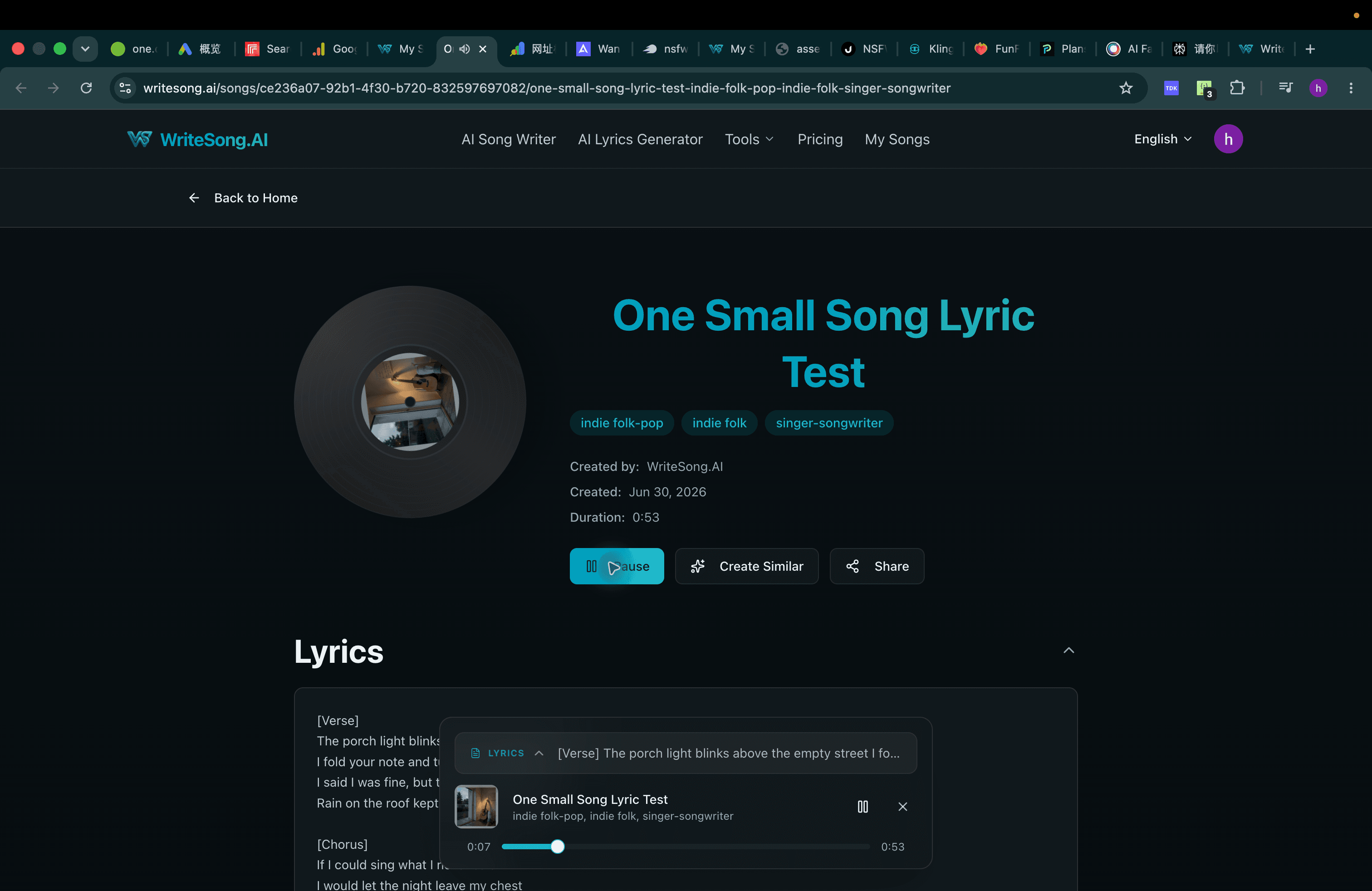
Searchable lyric excerpt
[Chorus] If I could sing what I never said / I would let the night leave my chest / Turn this quiet into something true / One small song to reach back to you
| Review window | Listen for | Source lyric target | Claim status |
|---|---|---|---|
| 00:00-00:20 | Opening vocal and verse setup | The porch light blinks above the empty street / I fold your note and tuck it in my sleeve | Review checkpoint only; not a verified transcript or ClaimReview claim. |
| 00:20-00:55 | Chorus lift and hook clarity | If I could sing what I never said / One small song to reach back to you | Use this window to check hook preservation before making any formal claim. |
| 00:55-01:14 | Final phrase, outro space, and vocal intelligibility | One small song to reach back to you | Human listening notes are required before this becomes evidence for a narrow claim. |
One Small Song Lyric Test
Shorter draft, useful for checking whether the same lyrics can produce a tighter listening result.
Public song page verified with visible duration 0:53; MP3 downloaded through the browser media menu and verified locally at 53.184 seconds.
Best use: Use this as the comparison draft when you want to hear whether a shorter generation keeps the same lyric identity.
Mode: Custom Mode. Generated: 2026-06-30. Public tags: indie folk-pop, indie folk, singer-songwriter.
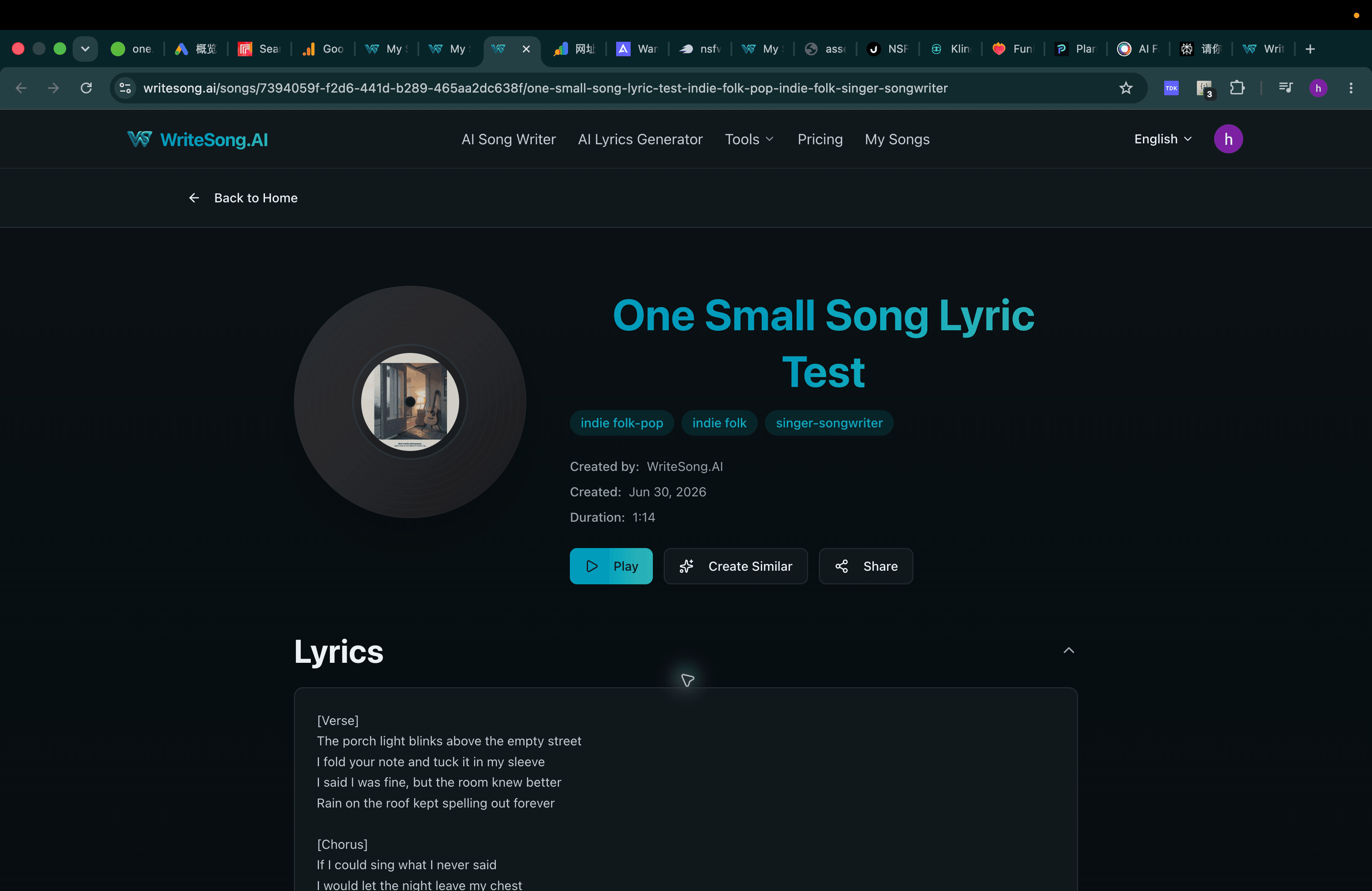
Searchable lyric excerpt
[Chorus] If I could sing what I never said / I would let the night leave my chest / Turn this quiet into something true / One small song to reach back to you
| Review window | Listen for | Source lyric target | Claim status |
|---|---|---|---|
| 00:00-00:15 | Opening line compression | The porch light blinks above the empty street / I fold your note and tuck it in my sleeve | Review checkpoint only; not a verified transcript or ClaimReview claim. |
| 00:15-00:40 | Hook arrival and syllable stress in AI vocals | If I could sing what I never said / Turn this quiet into something true | Use this window to test syllable stress and hook clarity before scoring the demo. |
| 00:40-00:53 | Ending clarity and repeat value | One small song to reach back to you | Human listening notes are required before this becomes evidence for a narrow claim. |
Demo Evidence Scorecard
This is an evidence-readiness scorecard, not a claim that one demo is objectively better music.
| Scorecard criterion | Result A | Result B | Note |
|---|---|---|---|
| Public availability | 5/5 | 5/5 | Both demos have public song pages plus local MP3 files available on the article page. |
| Evidence completeness | 5/5 | 5/5 | Both demos include duration, mode, model, public tags, audio player, public URL, screenshot, and source lyric context. |
| Searchable context | 4/5 | 4/5 | Both demos include chorus excerpts and review windows. A verified transcript would raise this to 5/5. |
| Lyric-fit quality score | Pending | Pending | Not scored until a human reviewer confirms exact hook timestamps and syllable-stress notes from listening. |
Editorial Listening Review
This public review note is safe to show because it describes evidence readiness without pretending that a final lyric-fit quality score has been signed off.
| Review field | Current value | Publication rule |
|---|---|---|
| Review owner | WriteSong.AI Editorial Team | A named team or reviewer must own the final listening note before any quality claim is published. |
| Short public review | Editorial note: these demos are strong enough to document a real lyrics-first workflow because both drafts are public, playable, and tied to the same source lyrics. They are not yet published as proof that the hook was preserved perfectly; the final lyric-fit score waits for a human reviewer to confirm exact hook timestamps and syllable-stress notes. | Safe to show as an editorial evidence note because it does not claim exact hook preservation or universal quality. |
| Result A lyric-fit score | Pending human sign-off | Score only after a reviewer listens to 00:20-00:55 and records exact hook start/end times. |
| Result B lyric-fit score | Pending human sign-off | Score only after a reviewer listens to 00:15-00:40 and records exact hook start/end times. |
| ClaimReview status | Not emitted | Emit only after a second listen confirms the narrow claim, timestamp, reviewer, and method. |
Lyric-Fit Scoring Rubric
Use this rubric for human review before turning any hook-preservation or syllable-stress observation into a formal claim.
| Rubric criterion | 1-5 score anchor | What to check |
|---|---|---|
| Hook clarity | 1 = hook buried or rewritten; 3 = hook present but uneven; 5 = hook clear, repeatable, and easy to remember. | Use the chorus review window to check how to preserve a hook in an AI song without overclaiming exact lyric preservation. |
| Syllable stress | 1 = important words rush or fall awkwardly; 3 = mostly natural with a few crowded lines; 5 = key words land cleanly. | Listen for syllable stress in AI vocals, especially on longer lines and emotional nouns. |
| Section contrast | 1 = verse and chorus blur together; 3 = some lift; 5 = clear verse setup and chorus payoff. | Compare the opening checkpoint with the hook checkpoint instead of judging only the final polish. |
| Vocal intelligibility | 1 = words are hard to understand; 3 = understandable with covered phrases; 5 = close vocal keeps the lyric easy to follow. | Check whether the arrangement leaves room for the lyric in the first and final listening windows. |
Evidence And Schema Status
| Evidence or schema item | Current status | Requirement before publishing |
|---|---|---|
| Audio demo | Published on this page as two MP3 demos. | Keep the local MP3 files, public song URLs, durations, tags, and browser screenshots together as one evidence package. |
| AudioObject schema | Emitted for the two visible MP3 demos. | Keep contentUrl, encodingFormat, duration, name, uploadDate, and on-page audio players aligned. |
| ClaimReview schema | Not emitted. | Use only for a narrow checkable claim, such as whether the generated chorus preserved the supplied hook, with before/after evidence on the page. |
| Editorial review note | Visible as reviewedBy and evidence-status copy. | Keep as editorial copy unless the page makes a factual result claim that deserves formal claim-level review markup. |
Publishing Evidence Checklist
| Demo field | Required value | Example |
|---|---|---|
| Source lyrics | The exact lyrics pasted into Custom Mode. | The [Verse] and [Chorus] sample from this article. |
| Style prompt | The exact style direction used for the run. | Intimate indie folk-pop, close lead vocal, preserve the hook. |
| Stable audio URL | A public URL or hosted file that remains accessible after publishing. | The two public song pages plus the on-page MP3 demo files. |
| Key screenshot | A visible public song page or player screenshot that matches the audio file and duration. | The article keeps public-page screenshots beside the 1:14 and 0:53 demo evidence. |
| Excerpt window | The part of the clip that demonstrates lyric fit. | Each demo now includes review windows for verse setup, hook clarity, and ending intelligibility. |
| Lyric-fit notes | Human review of hook, syllable stress, section contrast, and arrangement support. | Reviewer checks whether the hook is audible in the marked window and whether syllable stress in AI vocals feels natural. |
| Reviewer method | Who reviewed the claim and how they compared the source lyric against the audio. | Compare the original [Chorus] text against the on-page MP3, record exact start/end times for the hook phrase, then score hook clarity, syllable stress, section contrast, and vocal intelligibility before publishing any formal claim. |
| Rights note | Confirmation that the lyrics are original or licensed for this demo. | Original demo lyrics written for WriteSong.AI editorial testing. |
ClaimReview Preparation Pack
| Demo | Candidate claim | Source lyric position | Audio window | Reviewer | Method | Current status |
|---|---|---|---|---|---|---|
| Custom Mode result A | The supplied chorus hook is checkable in the longer 1:14 listening draft. | [Chorus], lines 1 and 4 | Candidate window: 00:20-00:55 | WriteSong.AI Editorial Team | Compare the original [Chorus] text against the on-page MP3, record exact start/end times for the hook phrase, then score hook clarity, syllable stress, section contrast, and vocal intelligibility before publishing any formal claim. | Prepared for review only. Do not emit ClaimReview until exact hook start/end times and a human listening note are recorded. |
| Custom Mode result B | The shorter 0:53 comparison draft can be checked for hook arrival and syllable stress. | [Chorus], lines 1-3 | Candidate window: 00:15-00:40 | WriteSong.AI Editorial Team | Compare the original [Chorus] text against the on-page MP3, record exact start/end times for the hook phrase, then score hook clarity, syllable stress, section contrast, and vocal intelligibility before publishing any formal claim. | Prepared for review only. Do not emit ClaimReview until exact hook start/end times and a human listening note are recorded. |
ClaimReview Template
| Template field | Required value | Example |
|---|---|---|
| Claim | One narrow factual statement, not a broad quality claim. | In Result A, the supplied chorus hook is audible in the generated draft. |
| Original lyric | The exact source line and section position. | [Chorus], line 4: One small song to reach back to you. |
| Audio evidence | Public MP3 URL plus exact start/end timestamp. | /site/blog/articles/write-a-song-from-your-own-lyrics/evidence/one-small-song-lyric-test-v5-custom-1m14.mp3, 00:20-00:55 after human confirmation. |
| Reviewer | Reviewer or editorial team that performed the second listen. | WriteSong.AI Editorial Team |
| Method | How the reviewer compared source lyric, generated audio, and rubric. | Compare the original [Chorus] text against the on-page MP3, record exact start/end times for the hook phrase, then score hook clarity, syllable stress, section contrast, and vocal intelligibility before publishing any formal claim. |
| Second listen | A separate pass that confirms the same timestamp and score before schema is emitted. | Second reviewer confirms hook timestamp and lyric-fit score before ClaimReview JSON-LD is added. |
ClaimReview Boundary
| Claim type | Evidence needed | Decision |
|---|---|---|
| Workflow claim | Product screenshots showing Custom Mode separates lyrics, style, title, and model choice. | Covered by the current evidence table; formal ClaimReview is not needed. |
| Audio result claim | Stable audio URL, player screenshot, duration, tags, transcript or lyric snippet, and timestamps. | Covered as output existence and duration evidence through AudioObject; timestamp review checkpoints are visible, but still not enough for a hook-preservation ClaimReview. |
| Hook preservation claim | Original hook line, generated chorus evidence, exact timestamp where the hook can be heard, reviewer name, and a short method note. | Eligible for ClaimReview only after a human reviewer confirms the hook moment and the before/after evidence is visible. |
| Quality claim | Defined review rubric and multiple examples, not one polished output. | Avoid broad claims such as best or high quality; keep the page tutorial-focused. |
The Four-Step Lyrics-First Workflow
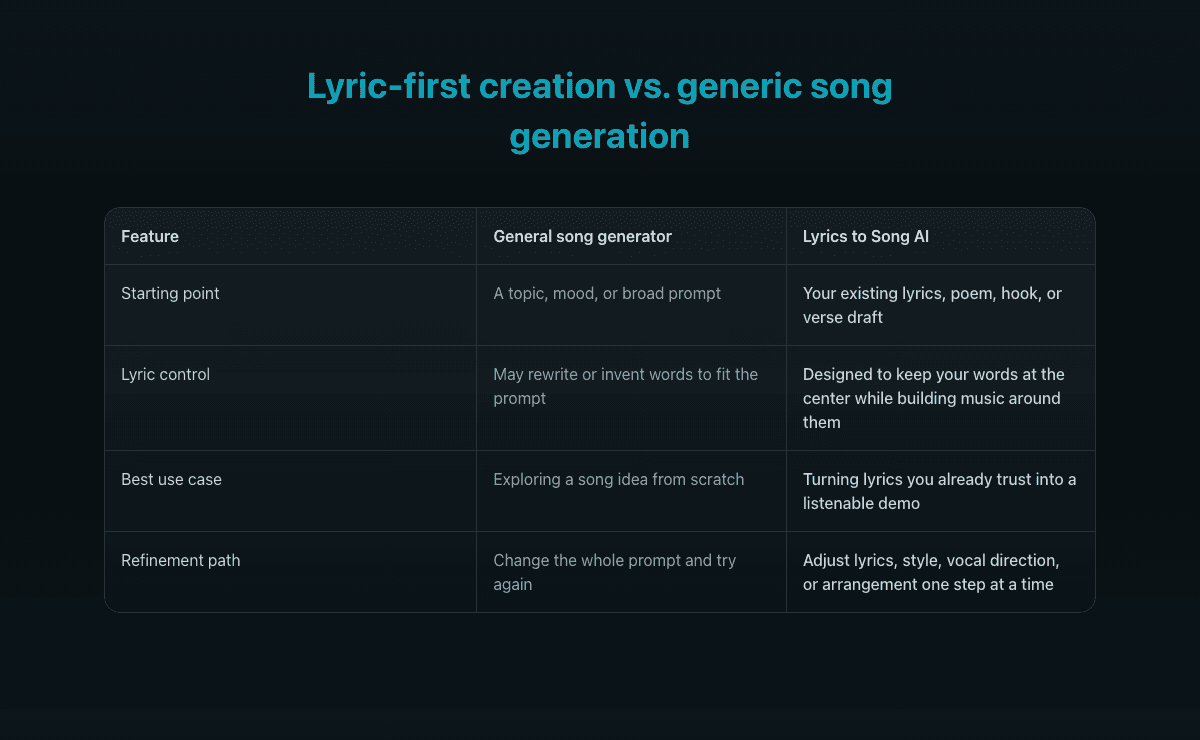
Use this lyrics-first workflow when the words already matter. The goal is not to ask AI for a random song; the goal is to hear whether your existing lyrics can become a clear listening draft.
1. Format lyrics before generation
Evidence: The product placeholder asks for clear section labels such as Verse and Chorus.
Paste lyrics with section labels, remove notes that are not meant to be sung, and keep the hook easy to find and preserve.
2. Put style outside the lyric text
Evidence: The Custom Mode form separates Lyrics from Style of Music and Title.
Keep genre, vocal role, instruments, and avoid rules in the style field so the model can treat the lyrics as source material.
3. Judge the first draft by lyric fit
Evidence: The Lyrics to Song page positions the workflow as words-to-listening-draft, not a one-click final master.
Run lyric fit testing: listen for lyric clarity, syllable stress, chorus lift, hook preservation, and whether the arrangement supports the emotional center.
4. Revise one variable at a time
Evidence: The page copy recommends adjusting lyrics, style, vocal direction, or arrangement one step at a time.
Do not rewrite everything after one miss. Name the mismatch and change only the next useful control.
Start With Lyrics The Model Can Sing
You do not need perfect lyrics, but the model needs enough structure. Put the sung words in the lyric box, mark the chorus, and keep production notes out of the lyric text.
Copy-ready lyrics example
[Verse]
The porch light blinks above the empty street
I fold your note and tuck it in my sleeve
I said I was fine, but the room knew better
Rain on the roof kept spelling out forever

[Chorus]
If I could sing what I never said
I would let the night leave my chest
Turn this quiet into something true
One small song to reach back to you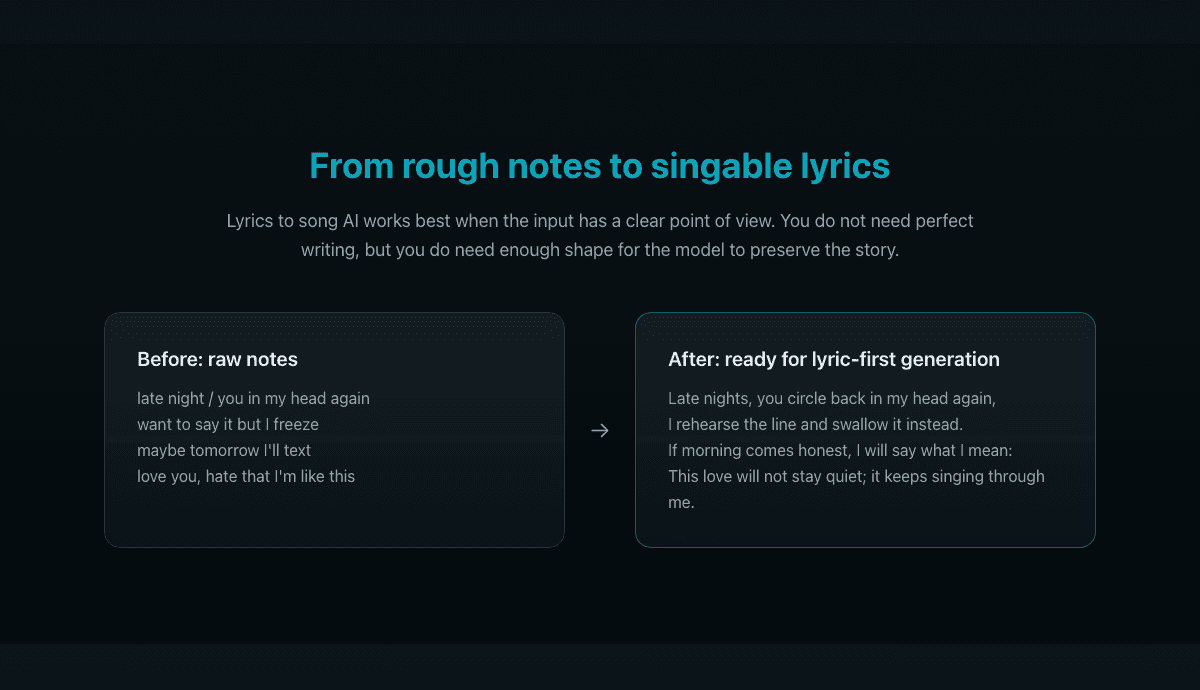
Put Style Direction Outside The Lyrics
Style instructions should tell the model how to perform the lyrics, preserve the hook, and avoid the wrong sound, not rewrite the lyrics into a new story.
Copy-ready style direction
Generate a complete lyric-first song from these lyrics.
Style: intimate indie folk-pop, warm acoustic guitar, soft piano, brushed drums.
Vocal: close lead vocal, clear lyric delivery, emotional but restrained.
Tempo feel: medium-slow, steady enough for the chorus to breathe.
Preserve the hook and keep the lyrics as the source material. Do not turn it into EDM, rap, or a big theatrical ballad.
Run A Lyric Fit Test
Before you trust the draft, check whether the music protects the lyric. This gives readers, search engines, and AI answer engines a concrete way to understand what good output means.
| Lyric fit test | Pass signal | Repair move |
|---|---|---|
| Hook preservation | The chorus phrase is audible, repeatable, and not rewritten into a different idea. | Move the hook into [Chorus] and add: preserve this phrase exactly and keep it easy to hear. |
| Syllable stress | Important words land naturally instead of rushing across the melody. | Split long lines, remove filler syllables, and ask for clearer vocal phrasing. |
| Section contrast | Verse sets the scene; chorus lifts or focuses the emotional point. | Shorten the chorus, give it simpler vowel endings, or reduce verse density. |
| Lyric identity | The song still feels like your lyric, not a generic rewrite of the topic. | Tell the model to keep the meaning, point of view, and named images as source material. |
| Arrangement support | The instruments leave space for words instead of covering the vocal. | Lower the energy, simplify drums, or request a closer vocal and lighter arrangement. |
Review The First Draft Like A Songwriter
The first output is evidence. Do not decide only by whether it sounds polished. Check whether the song protected the words you cared about.
| Check | Listen for | First fix |
|---|---|---|
| Section clarity | Does the verse feel like a verse and the chorus feel like a chorus? | Add [Verse], [Chorus], [Bridge], or [Outro] labels and shorten mixed sections. |
| Hook preservation | Is the main phrase audible, repeated enough, and not buried? | Move the hook into the chorus and mention that it should stay clear. |
| Syllable stress | Do long lines rush, flatten, or land on awkward words? | Split long lines, reduce filler, and keep one emotional action per line. |
| Vocal role | Does the voice fit the story and point of view? | Add close male vocal, intimate female vocal, duet contrast, or another clear role. |
| Arrangement fit | Does the music support the lyric or overpower it? | Name instruments, tempo feel, energy level, and styles to avoid. |
Use A Short Fix Map
When a draft misses, turn the problem into one focused instruction. This is easier to reuse than rewriting the whole prompt.
| If the draft has this problem | First action | Copy-ready instruction |
|---|---|---|
| Hook buried | Move the hook to the chorus and make the vocal clearer. | Keep the same lyrics, but make the chorus hook easy to hear and repeat it at the start and end of the chorus. |
| Lines feel rushed | Reduce syllable load before changing style. | Keep the meaning, but slow the vocal phrasing and let each line breathe before the next line begins. |
| Wrong genre or energy | Change style direction only. | Keep the lyrics unchanged. Shift the arrangement to [genre], [tempo feel], [instruments], and avoid [wrong style]. |
| Vocal does not fit the story | Specify the singer role and distance. | Use a [close/intimate/bright/low] vocal that sounds like [speaker role], with clear lyric delivery. |
| Song feels generic | Protect concrete images and point of view. | Keep the named images and first-person point of view. Do not replace the lyric with a broad inspirational version. |
Revise One Control At A Time
When the result misses, avoid rewriting everything. Name the mismatch and change only the next useful control.
Copy-ready revision template
If the first result misses the lyrics, revise one control at a time:

Lyric issue: [unclear section / awkward line / hook not protected]
Style issue: [too big / too slow / wrong genre / unclear vocal]
Next prompt: Keep the same lyrics, but change [one control]. Make the vocal delivery [specific delivery], the arrangement [specific texture], and keep the chorus hook easy to hear.
If the words are not ready yet, use the AI Lyrics Generator before opening full-song generation. If you are starting from only a topic or mood, use AI Song Writer or the broader guide to writing a song with AI.
Related Workflows
Use these related pages when the task changes: lyrics-first generation, lyric cleanup, idea-first writing, or broader AI songwriting workflow.
Lyrics to Song AI
Turn sectioned lyrics into a full listening draft.
Use this for the lyrics-first workflow and Custom Mode demos.
AI Lyrics Generator
Improve rough notes before full-song generation.
Use this when your words need cleanup before lyric fit testing.
AI Song Writer
Start from a topic, mood, or story instead of finished lyrics.
Use this when you do not already have lyrics to preserve.
How to Write a Song with AI
Learn the broader writing workflow around AI drafts.
Use this for song structure, prompt iteration, and revision strategy.
FAQ
Can I write a song from my own lyrics with AI?
Yes. Use a lyrics-first or Custom Mode workflow: paste lyrics with clear sections, add style and vocal direction separately, generate a draft, then revise based on what you hear.
Should I use Simple Mode or Custom Mode for my own lyrics?
Use Custom Mode when your lyrics matter. Simple Mode is better for broad ideas. Custom Mode separates lyric text from style, title, and vocal direction, which gives you cleaner control.
Will the AI keep my exact lyrics?
Treat exact lyric preservation as something to check, not assume. Clear section labels and focused style instructions help, but you still need to listen and revise if lines are changed, rushed, or buried.
How do I preserve the hook when turning lyrics into a song?
Put the hook inside a clear Chorus section, keep the phrase short, and tell the model to keep that phrase audible and repeatable. After generation, use a hook preservation demo window to check whether the phrase lands where you expected.
What is lyric fit testing?
Lyric fit testing means listening for whether the melody, syllable stress, vocal delivery, section contrast, and arrangement support the words instead of flattening or rewriting them.
How should I check syllable stress in AI vocals?
Listen for the words that carry the meaning. If those words rush, fall on weak beats, or disappear under the arrangement, shorten the line or ask for clearer vocal phrasing before changing the whole style.
Are the demo timestamps verified transcripts?
No. The timestamp windows are review checkpoints for listening, lyric fit testing, and future human scoring. They are not formal transcripts and they are not used as ClaimReview evidence yet.
What would make this page ready for ClaimReview?
A ClaimReview-ready update needs a narrow claim, the original lyric line and position, exact audio start and end times, the reviewer name, and a short method note explaining how the reviewer compared the source lyric with the generated demo.
Why does this page include AudioObject structured data?
This page includes AudioObject because the exact article demos now have stable on-page MP3 files, public song URLs, durations, format, title, upload date, and visible player evidence.
Should this article use ClaimReview schema?
Only use ClaimReview for a narrow factual claim backed by visible evidence, such as whether a generated chorus preserved the supplied hook. Do not use it just to make an ordinary tutorial sound more authoritative.
What should I fix first if the song sounds wrong?
Fix the clearest mismatch first: lyric formatting, hook clarity, vocal role, tempo feel, or arrangement texture. One focused revision is usually more useful than rewriting the whole prompt.
Can I paste copyrighted lyrics into an AI song generator?
Only paste lyrics you wrote or have permission to use. Do not use copyrighted lyrics from other writers unless you have the rights to reuse them in an AI generation workflow.
Read next
Continue through the blog cluster
AI Song Writer vs. Lyrics Generator vs. Song Generator
A workflow-based comparison that helps you choose between AI Song Writer, AI Lyrics Generator, and AI Song Generator.
Read articleHow to Write Better Choruses with AI
A chorus rewrite workflow with a prefilled prompt link, copy/run/download tracking, a 25-point scorecard, and clear text-level proof boundaries.
Read articleStart with the lyrics you trust.
Paste your own words, add focused style direction, and use the first generated draft as evidence for the next revision.
Create a song from lyrics