
Can AI Really Write Songs? A Practical Test
I ran a new WriteSong.AI test from the visible web app: one detailed prompt, two generated Bus Stop After Midnight candidates, and a practical answer to whether AI can really write songs.
Reviewed by WriteSong.AI Editorial Team on June 30, 2026. Evidence status: browser front-end generation record, dated My Songs screenshot, two visible runtimes, expanded review notes, and a clear listener-test gap.
Short Answer
Yes, AI can write a complete song draft when complete means a generated, playable song candidate with runtime, voice, music, and a finished library card.
In this fresh test, WriteSong.AI turned a detailed bus-stop prompt into two completed candidates. That is enough to answer the basic question: AI can write song-shaped drafts, not just lyric ideas.
The stronger answer is still human-centered: the AI generated material, while the human supplied the scene, boundaries, review criteria, metadata cleanup, and final judgment.
Evidence Summary
This is a practical field test, not a universal benchmark. The important part is the visible chain from prompt to completed candidates to bounded conclusion.
Test Parameters
| Tool | WriteSong.AI |
|---|---|
| Surface used | Visible web app workflow only: form, generate button, My Songs list |
| Evidence date | June 30, 2026 |
| Prompt title | Bus Stop After Midnight |
| Model shown in My Songs | Model V5 |
| Mode shown in My Songs | Custom |
| Candidates generated | 2 |
| Visible runtimes | 1:56 and 1:57 |
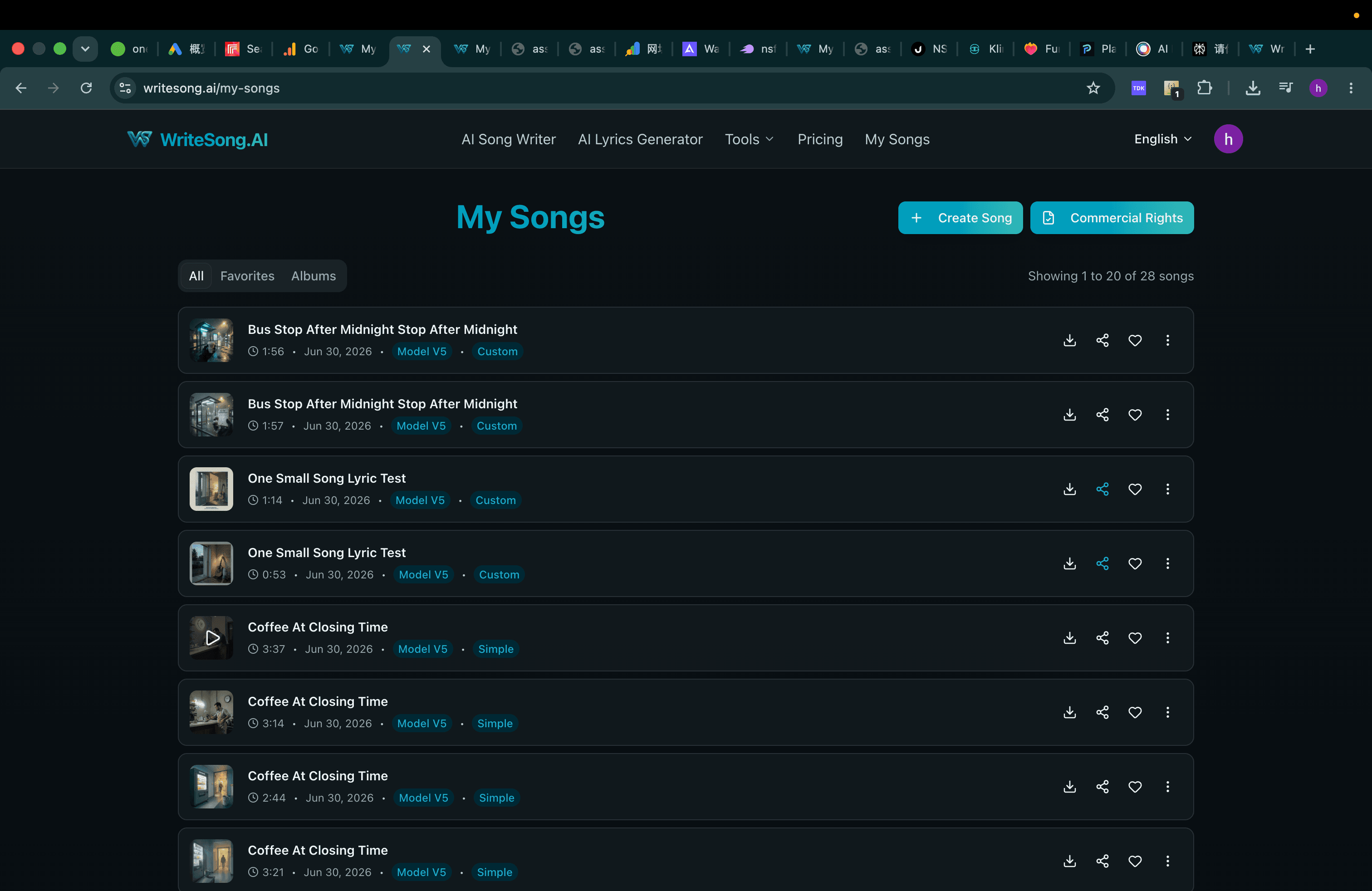
| Timestamp evidence | The embedded My Songs screenshot shows both completed candidates dated Jun 30 2026. |
| Public audio proof | Not claimed. No stable public share page or AudioObject schema is used for this run. |
| Evaluation lens | Completion, prompt control, metadata cleanliness, candidate variation, review readiness, and publish readiness |
| Evidence | Observed | Interpretation |
|---|---|---|
| Fresh independent test | The article uses a new Bus Stop After Midnight generation run instead of the older One Small Light evidence set. | The proof asset is harder to copy and directly answers the audit gap. |
| Complete song form | The My Songs page showed two finished Bus Stop candidates with runtimes of 1:56 and 1:57. | AI can produce a complete short song draft from a detailed prompt, not only lyrics or a concept. |
| Prompt specificity | The prompt specified speaker, place, time, wrong-adjacent stories, hook rule, concrete images, instruments, and avoid list. | The useful test is not whether AI writes from nothing. It is whether AI follows a precise creative brief. |
| Metadata artifact | The generated cards show the title as Bus Stop After Midnight Stop After Midnight because the title field had a duplicated tail during submission. | This is useful evidence against autopilot publishing: humans still need to clean metadata and inspect the run. |
| Candidate variation | Two candidates finished from the same submitted brief with nearly equal runtimes and different cover images. | A fair article should compare candidates instead of judging from a single lucky or unlucky output. |
| Claim boundary | The test did not create a public share link, download audio, or run a blind listener panel. | The article can support a grounded draft-quality claim, not a hit-song, public-audio, or audience-preference claim. |
Evidence Snapshot and Limits
The screenshot is useful evidence, but it is not stronger than what it shows. This section keeps the proof boundary explicit.
Generation snapshot
The embedded My Songs screenshot is the primary proof asset. It shows both Bus Stop candidates, Jun 30 2026 dates, runtimes, Model V5, Custom mode, and the duplicated title artifact.
Playback evidence boundary
The run did not produce a stable public share URL for this article. The page therefore avoids audio embeds, download claims, and AudioObject schema.
Listener evidence boundary
No 3-person blind score is claimed. The article lists the listener data still needed before making audience-preference or release-readiness claims.
The Submitted Brief
The prompt was intentionally specific. It described the singer, place, time, emotional frame, hook behavior, production texture, and wrong directions to avoid.
Copy-ready test prompt
Write an intimate indie pop song called "Bus Stop After Midnight". The singer is a night-shift barista waiting alone at a bus stop at 12:40 a.m. after closing the cafe, holding a paper cup gone cold. This is tired resilience, not a breakup, grief, or missing someone. Start with fluorescent light and rain on the shelter, then move toward small relief when the bus arrives. Use "still here, still moving" as the chorus hook, no more than twice per chorus. Include wet pavement, a bus timetable, cold coffee, a cleaning rag in the pocket, and first headlights. Keep the production warm and close: acoustic guitar, soft piano, brushed drums, restrained bass, intimate vocal. Avoid EDM drops, rap verses, cinematic drums, huge choir vocals, and generic motivational slogans.Style field
intimate indie pop, acoustic guitar, soft piano, brushed drums, restrained bass, close warm vocal
The Two Generated Candidates
The result set matters more than one output. Both candidates completed, but the visible title artifact also shows why publication still needs human inspection.
Bus Stop After Midnight Stop After Midnight
Shown as the first completed Bus Stop result in My Songs after the front-end generation run.
Useful as a short complete draft; still needs title cleanup, lyric inspection, and playback review before publication.
Bus Stop After Midnight Stop After Midnight
Shown as the second completed Bus Stop result in the same My Songs result set.
A necessary comparison candidate; the near-identical runtime makes hook clarity and story adherence the deciding factors.
Candidate Comparison Matrix
| Metric | Candidate A | Candidate B | Editorial takeaway |
|---|---|---|---|
| Completion signal | Finished card, 1:56 runtime | Finished card, 1:57 runtime | Both are valid short-song drafts; neither should be judged as release-ready without lyrics, playback, and metadata checks. |
| Metadata cleanliness | Title duplicated Stop After Midnight | Title duplicated Stop After Midnight | The same visible issue appears on both results, so title cleanup is mandatory before any public share. |
| Comparison value | First visible result from the run | Second visible result from the run | The pair lets an editor compare story fit, hook clarity, and arrangement instead of relying on one output. |
| Publish readiness | Draft-ready, not release-ready | Draft-ready, not release-ready | A release decision needs lyric inspection, playback notes, and optional listener scoring. |
Manual Review Log
This section is deliberately conservative. It is an editorial evidence review, not a 3-person blind listening panel, and it marks what still needs a true listening pass.
| Checkpoint | Result | Editorial note |
|---|---|---|
| Completion | Pass | Both candidates moved from generation progress to finished My Songs cards with runtimes. |
| Length and structure risk | Needs review | The 1:56 and 1:57 runtimes are complete short drafts, but they are shorter than a typical three-minute pop arrangement. |
| Story boundary | Needs lyric check | The prompt rejects breakup, grief, and missing-someone plots. A release decision should verify that the generated lyrics obeyed that boundary. |
| Hook behavior | Needs playback pass | The hook rule is clear: still here, still moving, no more than twice per chorus. The next human step is to check whether that line lands naturally. |
| Metadata cleanliness | Fail before cleanup | The visible title duplicated Stop After Midnight. That should be corrected before any public share, download, or indexable audio page is used. |
| Blind-listener status | Not claimed | This article does not invent a 3-person blind panel. It marks the missing listener data clearly and gives a next-step listener check. |
June 30, 2026, after the My Songs cards completed
Finding: Both results completed, but the visible title repeated Stop After Midnight.
Fix: Rename the selected candidate before sharing; keep the artifact visible in the article as proof that human inspection is still required.
June 30, 2026, article revision pass
Finding: The prompt asked for tired resilience rather than breakup, grief, or missing-someone framing.
Fix: Before publication, inspect lyrics against that story boundary and reject any candidate that drifts into a generic loss song.
June 30, 2026, pre-publish SEO pass
Finding: The test has screenshot evidence but no stable public audio URL or blind listener scores.
Fix: Use article, FAQ, HowTo, breadcrumb, and ImageObject evidence only; do not add AudioObject or listener-preference claims.
The Practical Scorecard
The scorecard answers the headline without turning one product test into an overclaim.
Can AI make a complete song draft?
Two Bus Stop candidates completed in My Songs with visible runtimes, model, mode, and song cards.
Can it follow a detailed song brief?
The test proves generation from a detailed brief, but final prompt adherence still needs lyric and playback review.
Can one output settle the question?
The run produced two candidates. The article compares them as a candidate set instead of treating one result as universal proof.
Can it publish itself without a human?
The duplicated title is a visible metadata flaw, and the article does not claim blind listener preference or release readiness.
Can it help a songwriter move faster?
The prompt turned a precise scene into two complete short drafts quickly enough to support a practical revision workflow.
What This Test Proves
The best AI-songwriting articles separate supported claims from missing proof. That is especially important for generative search answers.
AI can write a song-shaped draft.
Supported by this test
Supported by the two completed Bus Stop candidates visible in My Songs with runtimes, model, mode, and generated cards.
Not supported by this test
This does not prove every prompt will create a strong song or that the first output should be published.
AI understands your creative intent.
Supported by this test
Partly supported when the prompt gives a concrete speaker, scene, hook rule, production frame, and avoid list.
Not supported by this test
The article does not prove the final lyrics perfectly followed every prompt constraint without further lyric and playback review.
AI replaces songwriters.
Supported by this test
Not supported by this test.
Not supported by this test
The metadata issue, candidate comparison, and missing listener data all point to human authorship and editorial responsibility.
AI helps finish songs faster.
Supported by this test
Supported as a drafting workflow: submit a precise brief, get multiple candidates, inspect the mismatch, then revise.
Not supported by this test
It does not remove taste, rights review, mix judgment, audience testing, or final release decisions.
Reusable Test Prompt
Use this template when you want to test whether an AI song writer is following your idea or only producing a polished average.
Copy-ready AI song test prompt
Write a [specific genre] song called "[title]".
The singer is [specific person] in [specific place and time].
This is [emotional frame], not [wrong adjacent story].
Start with [opening image], then move toward [ending emotional turn].
Use "[hook phrase]" as the chorus hook, no more than [rule].
Include [3-5 concrete objects or images].
Keep the production [instruments, vocal texture, energy].
Avoid [wrong genres, plots, vocal styles, and cliches].

After generation, compare at least two candidates:
1. Did it become a complete song draft?
2. Did it keep the story frame?
3. Did the hook feel intentional?
4. Did the arrangement match the style field?
5. What still needs human editing before release?
For a deeper before-and-after prompt workflow, read the one-idea AI song prompt test. If your first result sounds generic, use the generic AI song diagnosis. For the broader authorship argument, see AI Cannot Write Songs.
FAQ
Can AI really write a complete song?
Yes, if complete means a generated song draft with runtime, vocal/music output, and a finished card in a song library. In this test, WriteSong.AI produced two completed Bus Stop After Midnight candidates.
Does this test prove AI can write a hit song?
No. This test proves a narrower point: AI can produce complete short drafts from a detailed prompt. Hit quality still depends on taste, editing, arrangement, audience response, and release context.
Why not use the older One Small Light evidence?
Because this article needed an independent test. The new Bus Stop After Midnight run avoids relying on an older proof set and adds a fresh screenshot, candidate table, and review log.
Why is there no AudioObject schema in this version?
The new test did not create stable public audio pages or public asset URLs as proof. The article therefore uses article, FAQ, HowTo, breadcrumb, and image evidence schema, but does not mark private library items as public audio objects.
What is the most important human step after generation?
Compare at least two candidates, clean metadata, check whether the lyrics obey the story boundary, and only then decide whether to revise, regenerate, or publish.
What would make this test stronger?
A stable public audio page and a small three-listener blind scorecard would make the evidence stronger. This version does not pretend those assets exist.
Read next
Continue through the blog cluster
From One Idea to a Song: A Real AI Song Prompt Test
One song idea, two prompt rounds, four generated songs, and the prompt revision that fixed the biggest story drift.
Read articleWhy AI Songs Sound Generic: 5 Prompt Fixes
Five practical prompt fixes for repetitive or unnatural AI songs, with before-and-after evidence and a copy-ready repair template.
Read articleThree next steps before you publish
Generate more than one candidate, check what the evidence really proves, clean the metadata, and only then test whether the song works for listeners.
Pick one candidate
Choose Candidate A or B only after checking lyrics, hook behavior, and arrangement fit against the original brief.
Clean the evidence
Fix the duplicated title, capture a clean player screenshot, and create a stable share page before adding public audio claims.
Run the listener check
Ask three listeners to score story clarity, hook memory, vocal fit, and publish readiness before calling it audience-tested.