
Why AI Songs Sound Generic: 5 Prompt Fixes
Generic AI songs need constraints, not more mood words. Fix them by naming the singer, story boundary, images, hook behavior, and arrangement texture.
Short Answer
AI songs sound generic when the prompt gives the model a mood but not a singer, a story boundary, concrete images, hook behavior, or arrangement texture. The fix is not simply a longer prompt. The fix is a more diagnostic prompt.
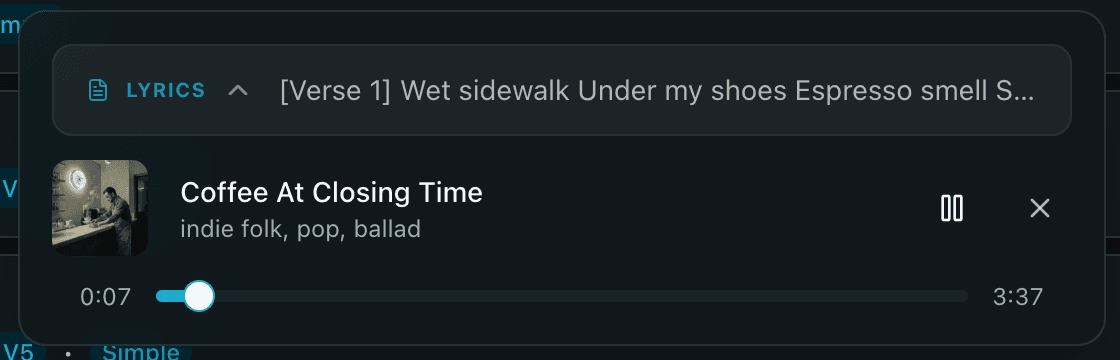
In the Coffee At Closing Time test, the broad prompt produced two candidates with useful but general signals. The revised prompt named a cafe worker, excluded breakup and quitting, supplied sensory images, controlled hook placement, and named instruments. The visible output moved from broad indie pop, warm, emotional toward a more specific indie folk, pop, ballad lane.
Evidence Summary
This is practical prompt-revision evidence, not a universal benchmark. Keep the setup small enough that another editor can repeat it without a meeting.
| Evidence | Observed value | Why it matters |
|---|---|---|
| Article role | Long-tail tutorial for why AI songs sound generic and how to revise them. | It supports the AI Song Writer hub without targeting the core term as the H1. |
| Evidence source | WriteSong.AI Simple Mode, Model V5, Coffee At Closing Time. | This article reuses the same foreground-browser test as a direct diagnostic extension of the prompt-formula article. |
| Test shape | Two prompt rounds, two candidates per round, no exposed seed. | The evidence is practical revision evidence, not a deterministic benchmark. |
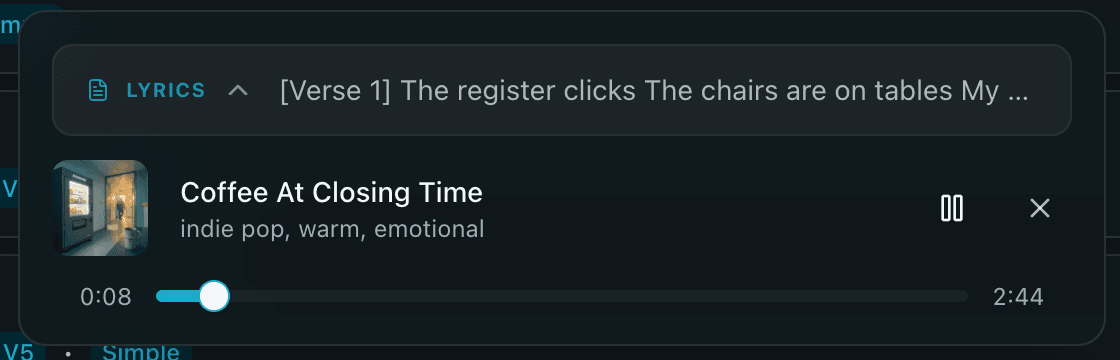
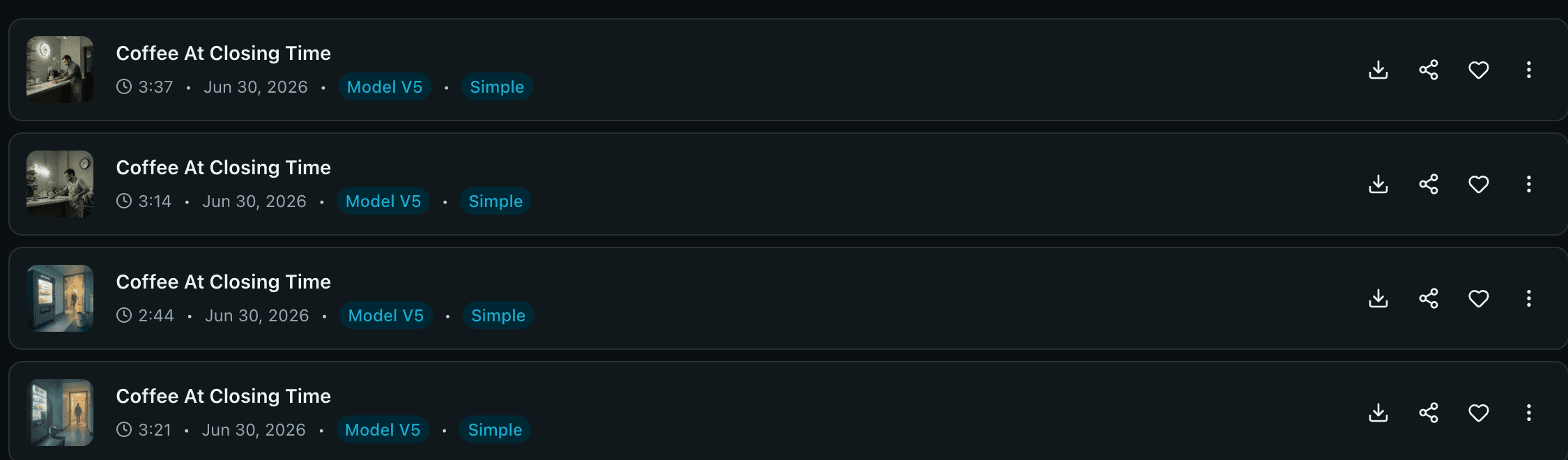
| Round 1 signals | Broad mood prompt, two candidates at 2:44 and 3:21. | The output was usable but leaned on general mood and broad public tags. |
| Round 2 signals | Specific worker, story boundary, images, hook rule, and texture. | The revised prompt produced candidates at 3:37 and 3:14 with more specific visible lyric imagery and different tags. |
| Limit | One product session. | Record model/version, prompt text, candidate count, and a quick blind-listen score for repeatability. |
The Generic Prompt And The Repaired Prompt
The first prompt is not bad. It has a title, genre, mood, and hook. It just leaves too many choices to the model. The second prompt repairs those choices.
Round 1: broad but plausible
Broad prompt
Write a catchy indie pop song called Coffee At Closing Time about leaving work late feeling tired and hoping tomorrow is better. Make it emotional warm and easy to sing. Use coffee at closing time as the chorus hook.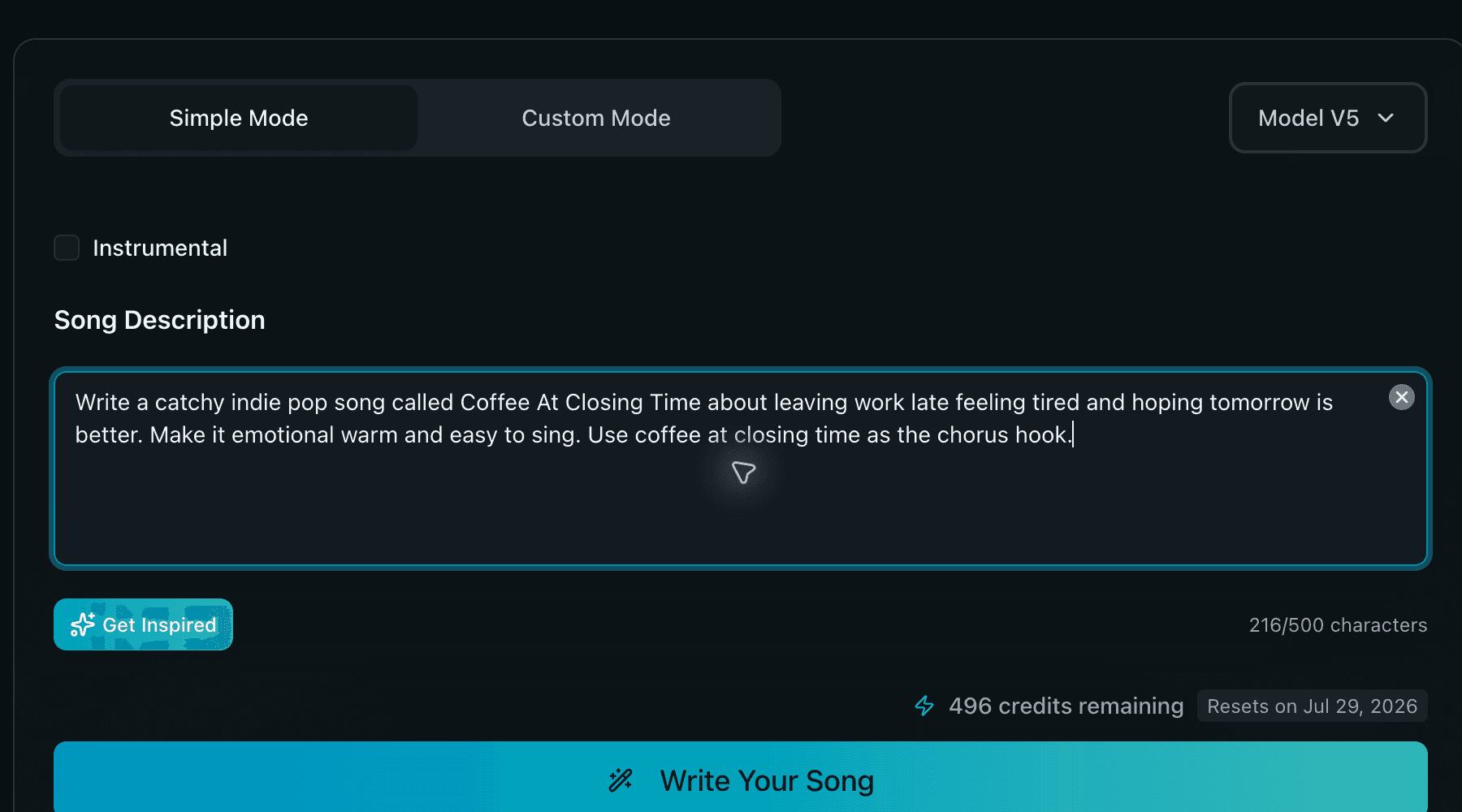
Round 2: repaired from evidence
Repaired prompt
Write an intimate indie folk-pop song called Coffee At Closing Time. The singer is a cafe worker locking the door after a double shift this is burnout and small self-respect not breakup or quitting. Images wet sidewalk espresso smell tip jar coins fluorescent light. Pre-chorus tired anger becomes one boundary. Chorus hook coffee at closing time at start and end. Keep brushed drums upright bass muted piano close vocal. Avoid EDM rap big ballad vocals slogans.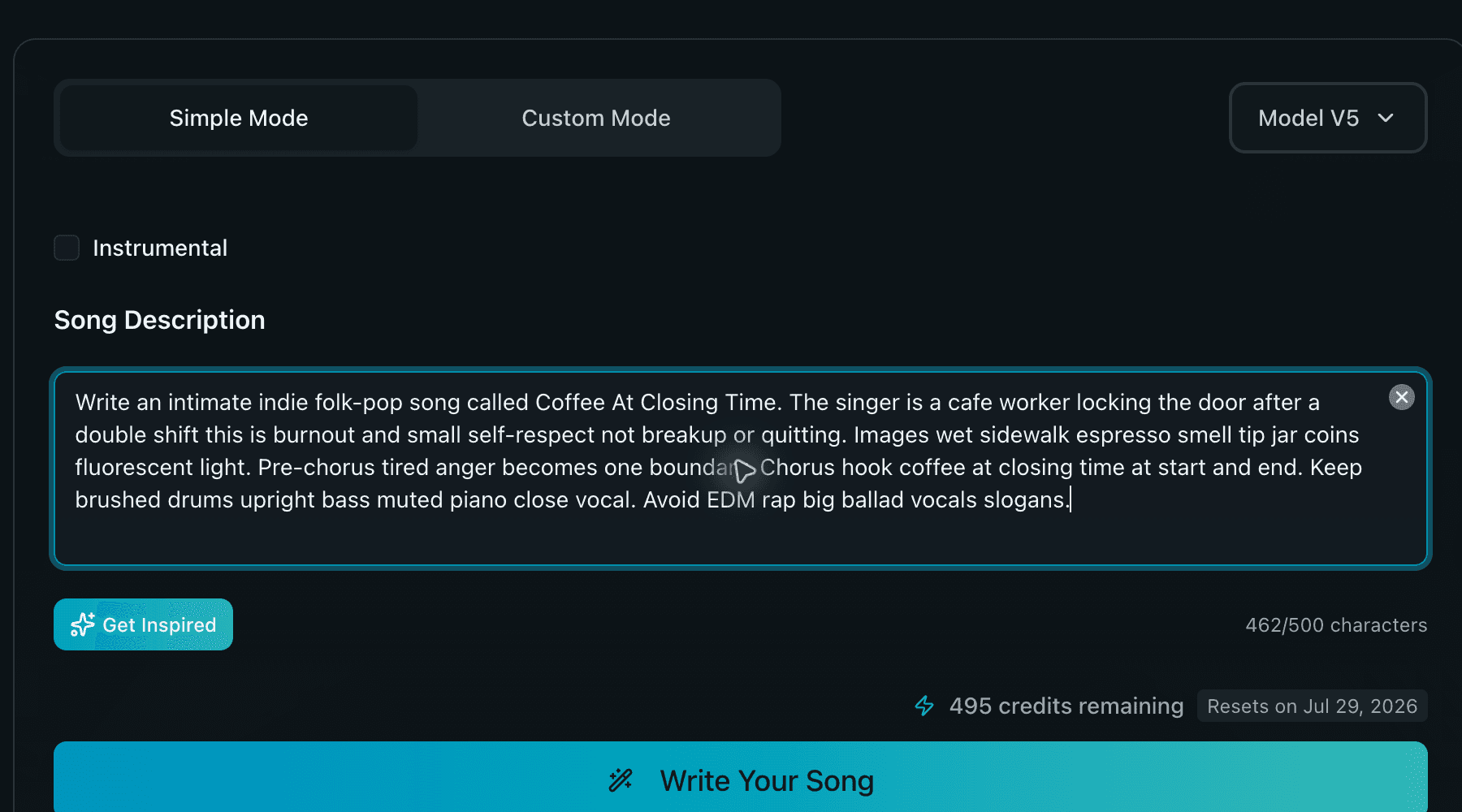
Visible Output Signals
One listen matters, but the quieter evidence is in the first lyric lines, tags, duration, cover direction, and whether you can say what changed.
Five Reasons AI Songs Sound Generic
Use these as a diagnostic sequence. Find the first reason that matches your output, then rewrite only the control that is missing.
1. The song has a mood, but no singer
Generic signal
The lyric could be sung by almost anyone because the prompt only says tired, hopeful, emotional, or catchy.
Evidence from the test
The broad prompt said leaving work late and hoping tomorrow is better. The revised prompt named a cafe worker locking the door after a double shift.
Give the model a role plus an action. A song gets less generic when a real person is doing something in a scene.
Prompt move
The singer is a [specific person] doing [specific action] in [place/time].
2. The prompt leaves the default story open
Generic signal
The output grabs a familiar adjacent plot: breakup, missing someone, quitting, grief, vague triumph, or motivational slogans.
Evidence from the test
The revised prompt did not only say burnout. It also said not breakup or quitting, which narrowed the emotional lane.
Name the story you want, then name the nearby story you do not want. This reduces drift without overexplaining every lyric line.
Prompt move
This is [core situation], not [wrong adjacent story].
3. The lyric only receives abstract feelings
Generic signal
The first verse sounds like a summary because the prompt gives emotions but few objects, places, sounds, smells, or images.
Evidence from the test
Round 2 supplied wet sidewalk, espresso smell, tip jar coins, and fluorescent light. The opened player showed the sensory lane immediately.
Give the lyric material it can sing. Concrete images are usually stronger than more adjectives.
Prompt move
Images: [object], [sound or smell], [place detail], [light or weather].
4. The hook is named, but not controlled
Generic signal
The hook phrase appears, but it repeats too often, lands in weak places, or never becomes the emotional turn.
Evidence from the test
The broad prompt only asked to use coffee at closing time as the chorus hook. The revised prompt told the hook to appear at the start and end.
Tell the hook where to land and how much repetition is enough. This gives the chorus a job instead of only a phrase.
Prompt move
Chorus hook: [phrase] at [position or repetition rule].
5. The arrangement is described with broad adjectives
Generic signal
The track sounds like a default preset because the prompt says warm, emotional, cinematic, catchy, or upbeat without naming texture.
Evidence from the test
Round 1 public tags read indie pop, warm, emotional. Round 2 asked for brushed drums, upright bass, muted piano, and close vocal, then showed indie folk, pop, ballad tags.
Describe the production as instruments, vocal distance, groove, and avoid rules. Tags and playback still need human checking.
Prompt move
Keep [drums], [bass], [keys/guitar], [vocal texture]. Avoid [genres or vocal shapes].
Generic Song Repair Checklist
Quick blind-test: rate Specificity / Emotion / Originality, each 1-5. Example: R1 = 3/2/2, R2 = 4/4/3.
| Check | Ask this | Repair move |
|---|---|---|
| Speaker | Can you identify who is singing and what they are doing? | Add a role, action, place, and time. |
| Story boundary | Did the output drift into a common but wrong plot? | Add a not-this-story line. |
| Images | Does the first verse contain specific objects or sensory detail? | Supply four singable images before regenerating. |
| Hook | Does the chorus use the hook with useful placement and restraint? | Set hook position or a maximum repetition rule. |
| Texture | Do public tags and playback match the intended sonic frame? | Name instruments, vocal texture, and avoid genres. |
Reusable Repair Template
Use this template after a generic first draft. Replace the bracketed fields with details from your own song idea.
Copy-ready generic-song repair prompt
Write a [genre] song called [title].
The singer is [specific person] doing [specific action] in [place/time].
This is [emotional frame], not [nearby story you do not want].
Images: [object], [sound or smell], [place detail], [light or weather].
Pre-chorus: [how the feeling turns].
Chorus hook: [exact hook phrase] at [placement or repetition rule].
Keep [instruments], [vocal texture], [tempo or groove].
Avoid [unwanted genre], [unwanted plot], [cliche lyric habit].
If your words are still weak before audio, start with the AI lyrics generator. If you want one idea turned into a complete draft with lyrics, music, and vocals, use AI Write Me a Song. For explicit male, female, or duet roles in a full production, open the AI Song Writer with Music and Vocals. For a personal birthday brief with a name and specific memories, try the Birthday Song Generator. For a broader workflow, read the guide to writing a song with AI.
Three-Step Quick Fix
Use the smallest edit that matches the evidence, then compare candidates instead of trusting one run.
Listen for the generic signal: unclear singer, default story, vague images, weak hook, or broad texture.
Rewrite only the missing control instead of asking for a better song.
Generate two new candidates and compare lyric opening, tags, hook behavior, playback, and blind-listen scores.
FAQ
Why do AI songs often sound generic?
Because prompts set mood but leave key songwriting choices undefined: who sings, the exact situation, concrete images, hook rules, and the arrangement texture.
How fast can I fix a generic AI song?
Often one prompt rewrite: change one missing control, such as singer or a specific image, regenerate, then run a 3-5 person blind listen.
How do I make the song sound less AI-written?
Add one small human detail, vary phrasing, avoid generic adjectives, and read or listen aloud to test for owned moments.
Read next
Continue through the blog cluster
AI Song Prompts That Actually Change the Output
Five practical AI song prompt formulas for writing songs with AI, each paired with fresh before/after evidence from Coffee At Closing Time.
Read articleFrom One Idea to a Song: A Real AI Song Prompt Test
One song idea, two prompt rounds, four generated songs, and the prompt revision that fixed the biggest story drift.
Read articleThe first draft is evidence, not the final verdict.
Let the first AI song show you what the prompt left blank, then repair the next prompt with a sharper singer, story, image, hook, and texture.
Fix your next AI song draft