
How to Write Better Choruses with AI: A Read-Aloud Hook Workflow
A better AI chorus usually comes from a sharper job: where the song hook lands, what the singer realizes, which image carries the turn, and what generic phrases should stay out.
Reviewed by WriteSong.AI Editorial Team on June 30, 2026. Evidence status: this article contains a text rewrite exercise, prompt, candidate scorecard, read-aloud hook test, and rubric. It includes downloadable resources and does not claim verified audio output.
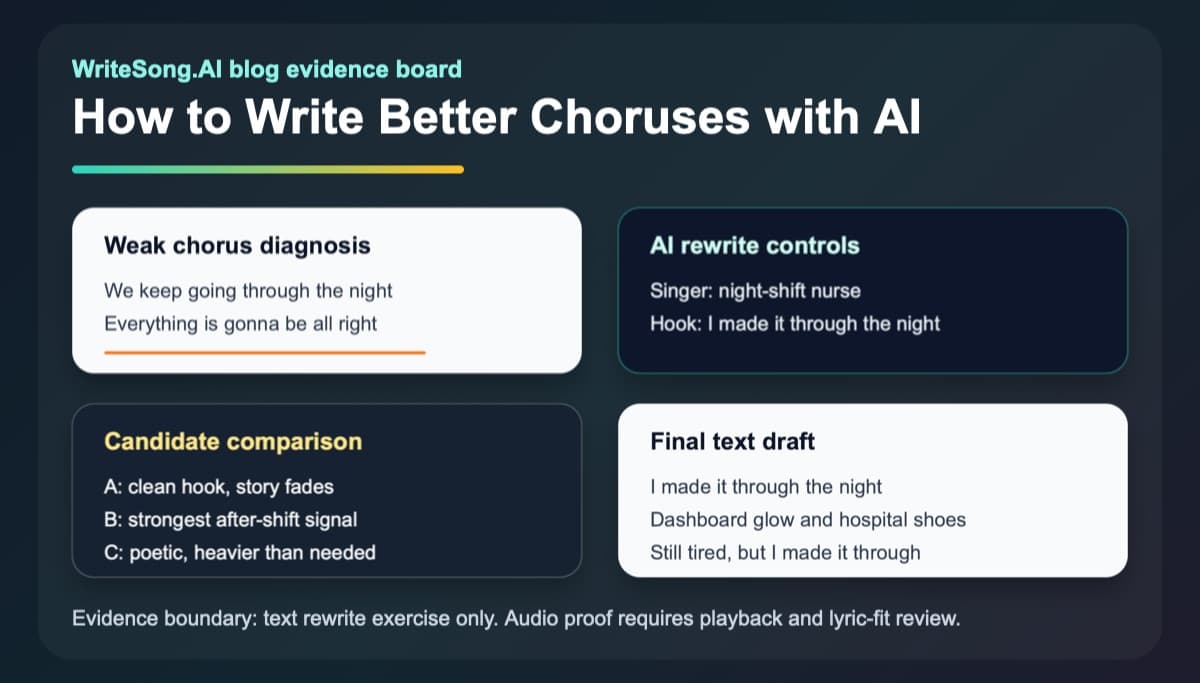
TL;DR: Fix the Hook Before the Song
A stronger AI chorus starts with a specific hook job: place the title phrase, give the singer a concrete scene, and read the result aloud before you turn it into a full song.
- Diagnose the weak chorus before asking an AI chorus writer for more options.
- Compare three candidates by hook placement, specificity, singability, emotional turn, and slogan control.
- Use the read-aloud hook test to catch rushed lines before audio generation makes them feel finished.
What This Workflow Covers
Main workflow
Prompt controls
Practical tests
5-Minute Test Path
Use this as a short product-assisted test: copy the prompt, open the prefilled editor, score the output, and keep the downloadable files beside your draft.
The copy, run, score, and download actions are tracked separately so this article can be evaluated as a product path, not just a pageview.
Short Answer
To write a better chorus with AI, do not ask for a catchier chorus in general. Tell AI the chorus job: the exact hook phrase, where that hook should land, how the chorus changes the verse emotion, which concrete image belongs in the refrain, and which generic phrases to avoid.
In the test below, a weak chorus became stronger only after the prompt named a singer, a situation, a chorus turn, and a short avoid list. The best result was not the most polished option; it was the option with the clearest hook behavior and the most specific story signal.
The practical test is simple: score the options, read the best one aloud, then move from AI Song Lyrics Writer to AI Song Writer only after the hook, refrain, and chorus section have separate jobs.
Evidence Boundary
This article follows the evidence-led SOP by separating text evidence from audio evidence. It can teach chorus revision, but it does not claim that the final chorus has already worked in a generated song.
Direct answer: This page proves a text-revision workflow, not finished audio performance. The evidence is the prompt, three candidates, scorecard, read-aloud notes, and final lyric draft.
Test Parameters
Machine-readable summary: article_slug=how-to-write-better-choruses-with-ai; evidence_type=text_rewrite_exercise; audio_claim=none; claim_review=not_emitted.
| Article role | Chorus-focused AI lyric workflow |
|---|---|
| Evidence type | Text rewrite exercise with visible prompt, weak draft, candidates, read-aloud test, downloadable resources, and rubric |
| Evidence date | 2026-06-30 |
| Input | One intentionally weak chorus draft |
| Output | Three chorus candidates, one scorecard, one read-aloud checklist, one prompt template, one scorecard CSV, and one focused revision |
| Product claim | No generated audio claim; this article covers lyric drafting before audio |
| Schema | BlogPosting, FAQPage, HowTo, BreadcrumbList; no AudioObject or ClaimReview |
| Evidence | Observed | Boundary |
|---|---|---|
| Weak draft | The starting chorus has a broad promise, no specific singer, no unique image, and four lines that could fit almost any song. | This proves the diagnostic setup, not that every weak chorus has the same problem. |
| Prompt controls | The rewrite prompt names the singer, situation, emotional turn, hook phrase, concrete images, line-length goal, and avoid list. | The article tests chorus-writing controls, not final vocal melody or production quality. |
| Candidate comparison | Three options are judged by hook placement, specificity, singability, emotional turn, and slogan control. | A text comparison can identify stronger lyric choices; playback is still needed before claiming the chorus sings well. |
| Final revision | The chosen draft keeps the exact hook, keeps the nurse after-shift image set, and removes broad slogan lines. | The final chorus is an editorial draft for the article, not a finished recorded song. |
Chorus Rewrite Example: Nurse After a Night Shift
The starting chorus is intentionally weak. It has a simple shape, but it does not yet sound like it belongs to a specific singer.
Direct answer: A stronger AI chorus prompt gives the model a singer, scene, emotional turn, exact hook phrase, concrete images, and avoid list before asking for options.
Starting point: weak chorus
Weak chorus
[Chorus]
We keep going through the night
Everything is gonna be all right
I can feel it in my heart
This is just a brand new start
Diagnosis
The draft has an easy shape, but every line is portable. There is no singer, scene, image, or emotional turn that would make a listener remember this song instead of another hopeful song.
Rewrite prompt
Controlled AI chorus prompt
Rewrite this chorus for an intimate indie pop song.

Song situation: a night-shift nurse driving home after a hard week.
Emotional turn: exhausted in the verse, quietly proud in the chorus.
Hook phrase: "I made it through the night."
Point of view: first person.
Concrete images to keep available: dashboard glow, hospital shoes, sunrise on the overpass.

Chorus job:
- Start with the hook phrase or land on it by line 2.
- Keep the lines short enough to sing.
- Make the chorus lift emotionally without turning into a slogan.
- Repeat one anchor phrase, not every idea.
- Avoid generic lines like "everything will be all right" or "brand new start."

Return three chorus options and one sentence explaining what each option does.
Compare 3 AI Chorus Writer Options
Do not choose the line that sounds most dramatic in isolation. Choose the option that best solves the chorus job for this song.
Direct answer: Candidate B is the best base because it leaves the hook and the nurse-after-shift image in memory after one read, even though one line still needs revision.
Candidate A: clean but still broad
[Chorus]
I made it through the night
With the dashboard burning low
I made it through the night
Now the morning lets me go
The hook is clear and repeatable. The weakness is that line 4 is still a little generic, so the nurse story could fade.
Keep the hook placement and the dashboard image.
Candidate B: strongest story signal
[Chorus]
I made it through the night
Hospital shoes on the passenger side
Sunrise on the overpass
I am still here, still driving
This is the best base because the chorus has a specific body, place, and after-shift image. It needs a slightly tighter final line.
Keep the hospital shoes, sunrise, and first-person survival tone.
Candidate C: most emotional, least specific
[Chorus]
I made it through the night
Carrying every name with me
I made it through the night
And the dark gave back the street
This has mood and a stronger poetic turn, but it adds a heavier implication that may not belong in a practical after-shift chorus.
Keep the darker vowel shape only if the song wants more grief.
| Option | Hook placement | Specificity | Singability | Emotional turn | Slogan control | Total | Verdict |
|---|---|---|---|---|---|---|---|
| Candidate A | 5/5 | 3/5 | 4/5 | 3/5 | 3/5 | 18/25 | Strong repeat, but the nurse-specific story can still disappear. |
| Candidate B | 4/5 | 5/5 | 4/5 | 4/5 | 4/5 | 21/25 | Best base: the story signal is strongest, even though the final line needs tightening. |
| Candidate C | 5/5 | 3/5 | 3/5 | 4/5 | 3/5 | 18/25 | Poetic, but the grief tilt may change the brief instead of improving it. |
Editor note: We chose Candidate B as the base because it kept the dashboard, hospital shoes, and overpass in the singer's body. The follow-up revision changed only the abstract ending.
Read-aloud note: On the first quiet read, the sticky elements were the exact hook "I made it through the night" and the physical image "hospital shoes." Candidate B won because it left both in memory.
Internal sample note: this is a text-level review of three AI chorus candidates from one controlled prompt, scored by one editor. It is not user research and it is not audio performance proof.
The Focused Revision
Once one candidate has the right story signal, revise only the weak part. Broad second rewrites often erase the thing that made the best option work.
Direct answer: The best follow-up prompt preserves the hook and story signal, then asks AI to fix only the weakest line or behavior.
Focused follow-up prompt
Use Candidate B as the base.
Make the hook more repeatable and make line 3 less abstract.
Keep "I made it through the night" exactly.
Keep the nurse after-shift situation visible.
Do not add a new plot, a new relationship, or a big inspirational slogan.
Revised chorus draft
[Chorus]
I made it through the night
Dashboard glow and hospital shoes
Sunrise finds me on the overpass
Still tired, but I made it through
This draft is still simple, but now the chorus has a specific body in it: dashboard glow, hospital shoes, sunrise, and the exact hook. The final line avoids a huge promise and stays closer to quiet endurance.
Read-Aloud Hook Test: One-Breath Lines
A chorus can look better on the page and still fail once a singer has to breathe through it. Use this text-level pass before you claim the hook is ready for audio.
Direct answer: A chorus is closer to singable when each line survives a slow one-breath read and the hook returns without feeling pasted on.
| Test | How to run it | Pass signal |
|---|---|---|
| One-breath line test | Read each line at a slow singing pace without adding melody. | No line forces a rushed second breath or an extra unstated syllable. |
| Hook-repeat test | Say the hook, one middle line, then the hook or final echo again. | The return feels earned instead of pasted onto the section. |
| Refrain memory test | After one read, cover the lyric and name the phrase and image you remember. | One exact phrase and one concrete image remain in memory. |
| Pre-chorus lift test | Read the last verse or pre-chorus line directly into chorus line 1. | The chorus answers, lifts, or turns the setup instead of repeating the same mood. |
Chorus Quality Checklist: Hook, Refrain, Singable Lines
Use this checklist before moving the lyric into full song generation. It keeps the writing problem visible before arrangement and vocal delivery make everything feel finished.
Direct answer: Most weak AI choruses fail because the hook arrives late, the emotional turn is vague, or the lines explain more than a singer can comfortably deliver.
| Check | Weak signal | Repair move |
|---|---|---|
| Hook location | The title phrase appears once or arrives too late. | Tell AI where the hook should land: first line, second line, last line, or first and last line. |
| Emotional turn | The chorus repeats the verse mood instead of changing it. | Name the turn: exhausted to proud, angry to resolved, lonely to open, scared to brave. |
| Specific image | The chorus uses only abstract words like heart, light, night, dream, and start. | Give two images that belong to this singer and this moment, then ask the model to use one. |
| Singable line length | Lines explain too much and would rush when sung. | Ask for short lines, one image per line, and one repeated phrase instead of a paragraph. |
| Slogan risk | The chorus says the moral of the song instead of letting the scene carry it. | Add avoid rules for generic promises, motivational slogans, and broad self-help language. |
What To Put In an AI Chorus Writer Prompt
A good AI chorus prompt is not only longer. It names the few controls that decide whether the hook feels earned.
Direct answer: The prompt needs the exact hook phrase, the singer's situation, the verse-to-chorus turn, one image set, and a short avoid list.
Singer and situation
A chorus gets stronger when the model knows whose body and memory are inside the hook.
a night-shift nurse driving home after a hard week
Verse emotion and chorus turn
The chorus should not simply repeat the verse. It should answer, lift, focus, or reveal something.
exhausted in the verse, quietly proud in the chorus
Exact hook or refrain phrase
If the phrase matters, preserve it. Otherwise the model may rewrite the title, hook, or refrain into a nearby idea.
I made it through the night
Hook, refrain, and chorus behavior
A hook is the memorable phrase; the chorus is the section. Tell AI how the phrase should return inside the section.
start with the hook phrase, then let the final line echo the refrain
Pre-chorus lift
The line before the chorus should make the hook feel like an arrival, not just the next sentence.
last verse line: the highway is empty; chorus line 1: I made it through the night
Avoid list
AI often fills choruses with familiar emotional defaults unless you block the wrong lane.
avoid 'everything will be all right' and 'brand new start'
A Reusable Workflow
The same method works whether you are fixing a pop hook, country refrain, worship chorus, rap hook, or creator song.
Direct answer: Use AI to generate controlled chorus options, not to decide the song's meaning for you. Pick one base, revise one weakness, then test the hook aloud.
1. Diagnose the weak chorus before asking for a rewrite
Evidence: The weak draft has no unique speaker, no concrete image, and no clear emotional turn.
Action: Name the missing control first: hook, situation, image, contrast, line length, or avoid list.
2. Ask for multiple chorus candidates
Evidence: Three candidates made the tradeoff visible: clean hook, story specificity, or poetic mood.
Action: Request options with short explanations so you can choose deliberately instead of accepting the first polished draft.
3. Keep one base and revise one problem
Evidence: Candidate B had the strongest story signal but needed a less abstract ending.
Action: Use a focused follow-up prompt that preserves the hook and changes only the weak line or behavior.
4. Run a read-aloud hook test
Evidence: The final draft looks cleaner, but the line length and hook return still need a human pass before audio.
Action: Read it slowly, check one-breath lines, and make sure the hook or refrain remains memorable after one pass.
5. Move to audio only after the chorus text has a job
Evidence: The final draft has a hook, images, and a turn, but no melody evidence yet.
Action: Use AI Song Lyrics Writer to finalize the section, then use AI Song Writer to test whether the hook sings clearly in a full song.
Chorus Rewrite Prompt Template (copyable)
Use this when you already have a chorus draft and need AI to help you create better options without replacing the whole song idea.
Direct answer: Copy this prompt when you already know the song idea but need three better chorus options with clear hook placement and singable lines.
Reusable chorus improvement prompt
Improve this chorus:

[Paste current chorus]

Song situation: [who is singing, where they are, what just happened]
Verse emotion: [what the verse feels like]
Chorus turn: [what changes in the chorus]
Hook phrase to preserve: "[exact phrase]"
Previous line or pre-chorus setup: [optional line that leads into the chorus]
Images that belong in the song: [2-4 concrete images]

Please return three chorus options.
For each option, explain:
1. Where the hook lands.
2. Whether the hook works as a title phrase, refrain, or chorus anchor.
3. Why the chorus feels different from the verse.
4. What risk I should listen for if I turn it into a full song.
Editor suggestion: paste the prompt into the lyrics tool first, then change only one field at a time. The fastest useful test is usually hook phrase, singer, and avoid list.
Blank scorecard CSV
Use the 25-point rubric to score your own chorus options.
Download blank CSVPrefilled example CSV
Compare your score against the Candidate A/B/C example from this page.
Download prefilled CSVPrompt TXT
Keep the copyable chorus rewrite prompt as a local text template.
Download promptRun the prompt
Paste the prompt into AI Song Lyrics Writer before moving to audio.
Run in AI Song Lyrics WriterWhere This Fits In WriteSong.AI
Fixing the chorus is a lyrics-first job. Use AI Song Lyrics Writer to sharpen the hook and refrain, then use AI Song Writer to hear whether the section lifts in a full draft.
Direct answer: Use AI Song Lyrics Writer first for chorus text, then move to AI Song Writer only after the hook, refrain, and section turn are clear.
Draft chorus options
Use the lyrics-only workflow first when you want alternate hooks, shorter lines, a cleaner refrain, or a clearer emotional turn.
Try this template in AI Song Lyrics WriterTurn it into a song
When the chorus has a job, move the best lyric into a full song draft and check whether the song hook actually lands.
Open AI Song WriterImprove the prompt
If the chorus still sounds generic, compare the prompt controls that changed another output test.
Read the prompt testAuthor and Review Notes
This article is written as an editorial workflow, not an automated success story. The goal is to make the human judgment visible before readers move into audio generation.
Author
WriteSong.AI Editorial Team, focused on lyrics-first AI music workflows, prompt design, and practical creator QA.
Review process
We checked the weak draft, prompt controls, candidate scorecard, and final revision against the article's stated evidence boundary.
Claim boundary
The page teaches text revision. It does not claim public audio proof, listener preference data, or a verified generated-song outcome.
FAQ
Can AI help me write a better chorus?
Yes, especially when you give it the chorus job, hook phrase, singer, emotional turn, image set, and avoid list. Do not ask only for a catchier chorus. Tell the model what the chorus must do.
What is the difference between a hook and a chorus?
A hook is the short memorable phrase or musical idea people remember. A chorus is the full repeated section that carries the main emotional point. A refrain is a returning phrase inside or around that section. In an AI chorus prompt, name both the exact hook phrase and how the chorus should use it.
What makes an AI-written chorus sound generic?
Generic choruses usually rely on broad promises, abstract emotion, and familiar phrases without a specific singer or image. Fix that by grounding the hook in a concrete situation.
Should I generate music before fixing the chorus?
Usually no. If the chorus text is vague, audio can make it feel more convincing without solving the writing problem. Fix the hook and emotional turn first, then test it in a full song.
How many chorus options should I ask AI for?
Ask for three. One option often hides the tradeoff. Three options let you compare clean hook placement, stronger story detail, and more poetic language.
Should I keep the exact hook phrase?
If the phrase is the title or emotional center, yes. Tell AI to preserve it exactly, then judge whether the surrounding lines make it feel earned.
Does this article prove the chorus will work as audio?
No. This article is a text-level chorus rewrite exercise. Before making an audio claim, you still need playback evidence, lyric-fit notes, and a check that the hook lands when sung.
Read next
Continue through the blog cluster
AI Song Prompts That Actually Change the Output
Five practical AI song prompt formulas for writing songs with AI, each paired with fresh before/after evidence from Coffee At Closing Time.
Read articleWhy AI Songs Sound Generic: 5 Prompt Fixes
Five practical prompt fixes for repetitive or unnatural AI songs, with before-and-after evidence and a copy-ready repair template.
Read articleReady to test your chorus in a full song?
First fix the lyric, hook, and refrain. Then test the section in a full song and listen for whether the chorus lifts when sung.
Text-level evidence only: this workflow improves chorus lyrics before audio generation; it does not prove the hook works in a finished recording.